Dutch Cinderellas with motorcycles (1)
We all know them: Cinderellas. According to Wikipedia, a Cinderella is "a stamp that at first glance resembles a postage stamp, but is not a postage stamp because it was not issued by the postal service of a country, territory, or (international) organization recognized by the Universal Postal Union."
You might initially think they're not interesting for a philatelist. But if you look closely, they can be quite beautiful, especially the older ones. And if they also feature an image of a motorcycle, my interest is triggered, and I'd love to add them to my collection.
Over the years, I've also seen and found several beautiful Dutch Cinderella stamps with motorcycle motifs. The oldest ones are from Simplex, a major Dutch manufacturer of bicycles, motorcycles and cars in the early 20th century. What I like most about them is that the actual subject on the stamp is "embossed," or pressed into the paper in relief. In the case of the Simplex stamps, there are even height variations within the image, making even relatively small details surprisingly visible. This gives them a true 3D effect. The background surrounding the image is printed in a single color; sometimes, some details within the image are also printed in the same color.
I know 4 different Simplex stamps, of which 2 with a motorcycle:
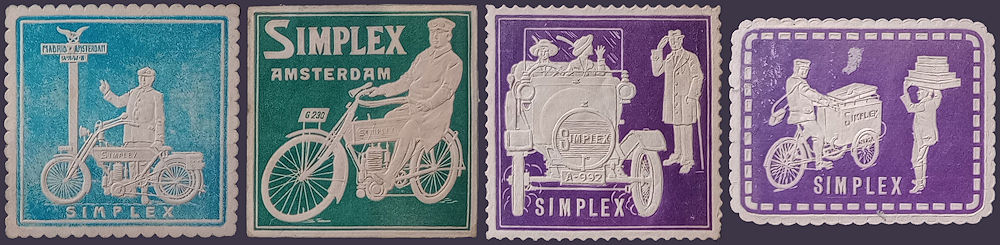
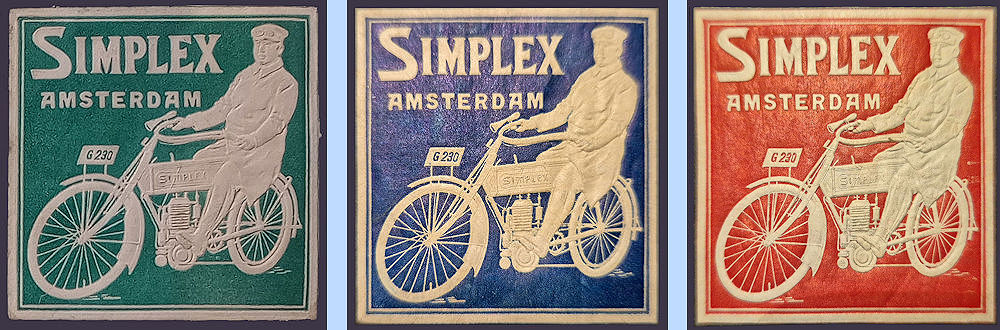
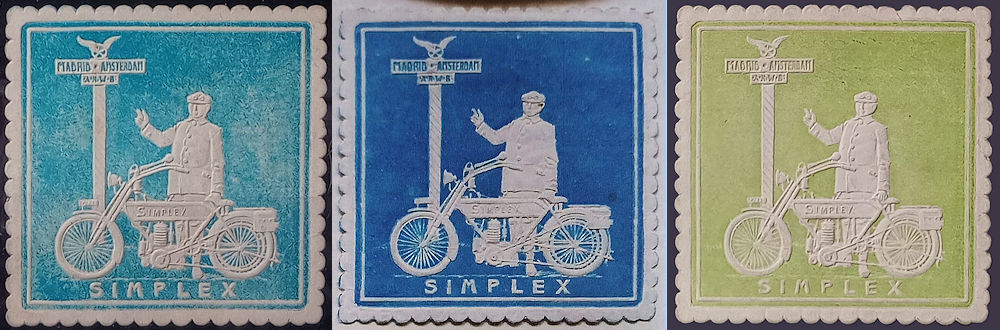
The 2 motorcycle stamps each exist in several colours. Here the versions that I know of:
I've seen the stamp with the delivery bike only in purple, the car also in green, dark blue and red.
Unfortunately, nothing can be found on internet about these Simplex stamps. Neither what they were made for (as a closing seal or just for advertising?) nor when. Since the stamps vary in size and design (edge finish), it seems likely that they are not issued as a single series, but are four individual issues.
Looking at the models depicted, it is possible to estimate the years of issue.
The easiest stamp is the one with the car. This is the two-seater "small car" or "cycle car" that Simplex introduced in 1912, in response to declining sales of the large and expensive cars of the past. In December 1913, a special motor and small car RAI fair (in Amsterdam) was held, in which Simplex also participated as a promotional event. This stamp is therefore likely from 1912 or 1913.
Simplex had been supplying delivery bicycles since 1903, but back then the cargo compartment was mounted behind the rider. In 1912, the first model with the rider sitting behind the compartment was released. I also found a photo of a delivery bicycle that strongly resembles the one on the stamp, from the 1916 "prijscourant" (price list). However, the painting is different in that one; the name Simplex is not horizontal, but diagonally upward, and the name "Amsterdam" is written below it. This stamp therefore likely dates from the period 1912-1915.
Dating the motorcycles is somewhat difficult, as Simplex introduced new models almost every year in the early 20th century, each one slightly different from the previous models, while older models often remained available.
On the stamp with the large motocycle image the license number G 230 is clearly readable:
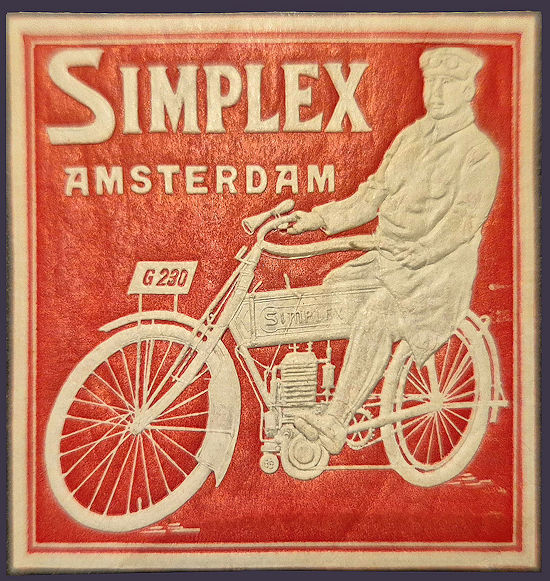
This license number was issued on February 1, 1906, in the name of Willem Karel van Erven Dorens from Amsterdam, who was Simplex's technical engineer. Therefore, the stamp cannot be any older. However, because these provincial license numbers were personal until 1950, and not linked to a vehicle, the same license plate could also have been used on different motorcycles (and cars) later on.
Looking at the motorcycles, I notice a few details. First, the partial shielding on the side of the front mudguard. This is first seen in images from 1913, while from 1915 onwards, the side shielding already ran along the entire length of the fender.
Second, the engine block. Simplex used Fafnir engines at that time. Until 1911, these had the intake valve on top of the cylinder, above the exhaust valve, so-called "inlet-over-exhaust" (IoE) engines. Only from 1912 onwards the Fafnir engines had two side valves. On the stamps the engine already appears to be a side-valve engine, as the characteristic high intake tube of an IoE engine is missing.
Although the bikes on the two stamps are very similar, the brand name on the tank is written differently. On the stamp with the large motorcycle, the "S" is larger than the other letters, and there appears to be a circle around the "S". A similar tank decoration was introduced in 1913. Before that, all the lettering was the same size, as on the motorcycle on the stamp with the road sign. In 1914, the brand name was again much smaller on the tank.
1913 also saw the release of the J.R. model, the first model with a frame top tube that wasn't completely straight, but curved slightly downward just before the seat. The motorcycle next to the road sign also has this; on the motorcycle on the other stamp, the end of the top tube isn't visible.
Unlike the one on the other stamp, the motorcycle on that stamp also has a luggage rack with a tool bag attached, a headlight, and a larger horn. So they are probably different motorcycles, but from the same period.
The ANWB road sign shows the names Madrid and Amsterdam. In the early years of car and motorcycle mobility, so-called reliability runs were often held between two places. Unfortunately, searching for such a run between Amsterdam and Madrid or vice versa has yielded no results, so this doesn't help with the dating.
In summary, it appears that all 4 Simplex stamps date from the period 1912-1913, with a possible extension up to around 1915.
Sources:
- "Simplex, Nederlandse fabriek voor rijwielen, motorfietsen, bromfietsen, automobielen en
railvoertuigen" by Pieter van der Ham (ISBN 9789070674410)
- Simplex thema issue of the Dutch Veteran Motorcycle Club (VMC)
The ANWB (originally the Dutch Club of Cyclists, later a general road traffic and tourism interest community) also issued beautiful Cinderellas with motorcycles on them.
The organization began teaching traffic safety at schools in 1924, a necessity due to the increasing number of motorized vehicles on the roads. Initially, they used booklets, the well-known school wall charts, posters, and even games.
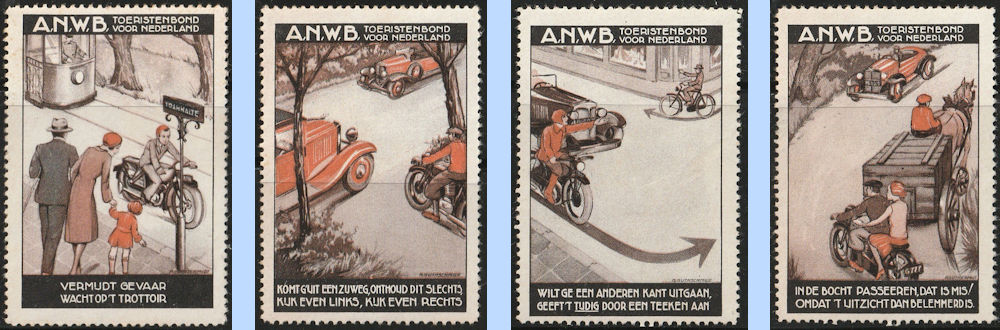
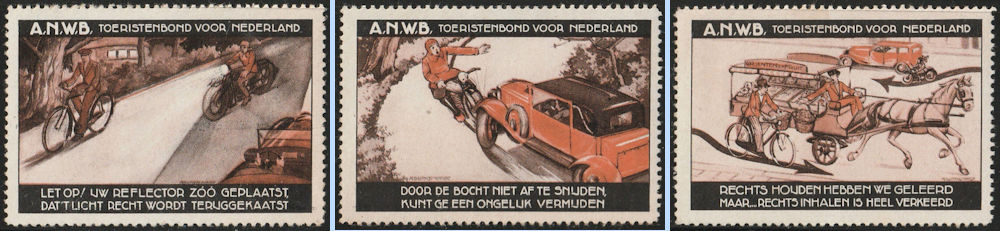
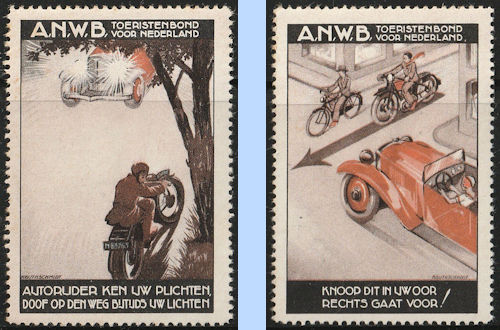
In 1932, a series of 24 educational closing seals was issued, 12 portrait and 12 landscape, depicting traffic situations and corresponding rules of conduct in verse. The stamps measure 65 by 45 mm and were printed in two colors, sepia and orange. The stamps were designed by Mathieu Güthschmidt, a well-known advertising designer.
Here are the 9 motorcycle stamps from that series:
Thanks to Martin Brouwer for supplying the images of the ANWB stamps
Later a series of 18 color stamps, each measuring 61 by 93 mm, was issued, each depicting an unsafe situation on the left and a safe situation on the right. I have one stamp from this series:
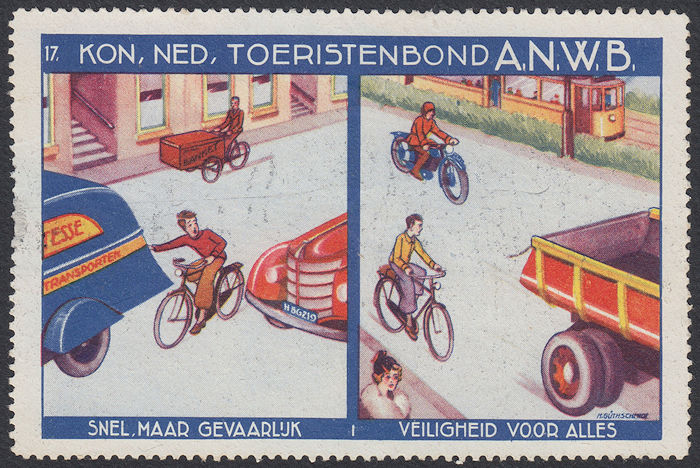
Texts: Fast, but dangerous (left), Safety above all (right)
In 1938, the ANWB also issued a series of stamps highlighting the organization's activities. Among them was this stamp featuring a motorcycle:
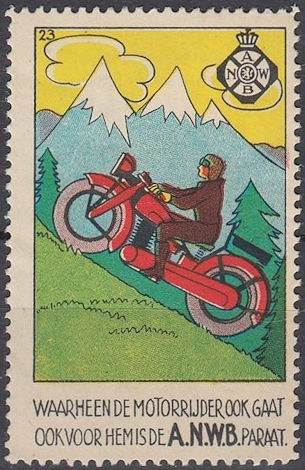
Text: Wherever the motorcyclist will go,
the ANWB will also be available for him
Paul Essens
Top - Back to former page - Home |