Thomas de la Rue, stamp printer and more
Many stamp collectors know the name 'De La Rue' as a printing company that prints stamps for many countries. But who founded this printing company with a French name, and where is it located? The literal translation of 'De la Rue' is 'From the Street', not an obvious name for a printing company. So where does it come from?
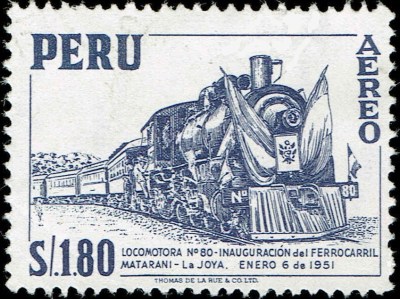
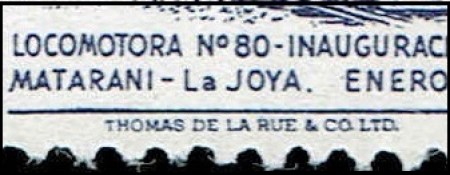
The stamp printing company often printed its name on the bottom edge of the stamps themselves. This example, for example, shows an airmail stamp from Peru issued on November 19, 1962, printed by Thomas de la Rue & Co Ltd. Here, the printing company's name is printed in full.
But who was Thomas de la Rue?
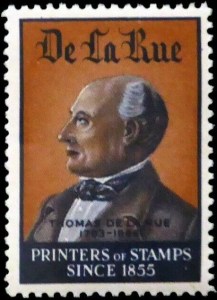
Here's a stamp with a portrait of Thomas de la Rue, the founder of one of the largest and most important printers of securities, banknotes, and stamps in the world. Thomas was born on March 24, 1793, on the island of Guernsey. This immediately explains Thomas's French name, as many villages and towns on the Channel Islands have French names, and many families also bear French names.
At the age of ten, he worked as apprentice with master printer Joseph Antoine Chevalier, and thus learned the printing trade. On February 6, 1813, he began printing his own newspaper, 'Le Miroir Politique', or the 'Political Mirror'.
In 1818, Thomas de la Rue and his family moved to London to start a completely new business. Not a printing works, but a factory where straw hats were made. In 1821, he started another new business there under his own name as 'printers and bookbinders'. In 1898, the family business was converted into a private company under the name Thomas De La Rue & Company, Limited.
Thomas de la Rue began printing tax stamps in 1853, when he received a contract from the British Board of Inland Revenue to produce gummed stamps and perforate them. This laid the foundation for the later production of many millions of stamps.
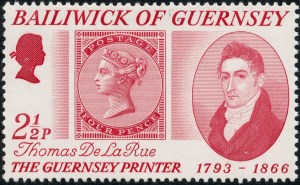
The first order for stamp printing was for the four-pence stamp depicted in the example above. This letterpress-printed stamp was first available on July 31, 1855. Orders from Britain's many colonies followed.
De la Rue printed stamps for the Cape of Good Hope, Mauritius, Western Australia, Trinidad, Ceylon, Hong Kong, Saint Helena, the Bahamas, Natal, Saint Lucia, and other colonies and dominions.
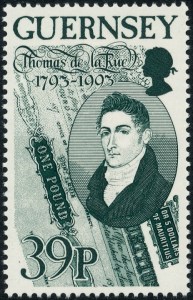
The first banknote was printed by De La Rue in 1860. These were Mauritian banknotes in the denominations of 10 shillings, £1 and £5. The stamp shows a fragment of the first Mauritian banknote, of one pound.
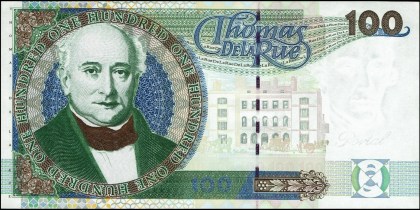
De La Rue became one of the most important banknote producers. Governments around the world ordered huge quantities of this type of security. The note pictured here is a test note, also used for presentation purposes, featuring a portrait of Thomas de la Rue. In the background is the facade of the printing works on Bunhill Row in London.
The first self-adhesive stamps, the so-called 'peel-off' system for British stamps, were developed by De La Rue. Pictured here is a test label featuring the silhouette of Thomas de la Rue.
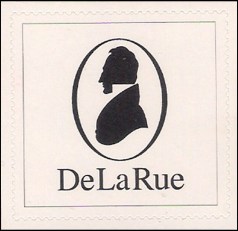
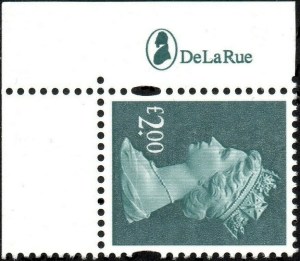
This silhouette can still often be found on the sheet edges of stamp sheets printed by De La Rue, such as this with a £2 stamp with a security perforation against counterfeiting, issued on February 17, 2009.
Thomas de la Rue, the versatile businessman and inventor, died at the age of 73 on June 7, 1866, in Kensington, London. He is buried in Kensal Green Cemetery in the Royal Borough of Kensington and Chelsea, London.
Now I can hear you thinking: "What does De La Rue have to do with our topic?"
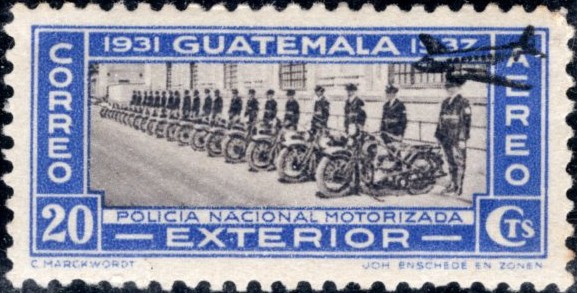
Stamps sometimes mention the name of the printing house where they were printed. For example, we know that the much-sought-after Guatemala stamp was printed by Joh. Enschede in Haarlem:
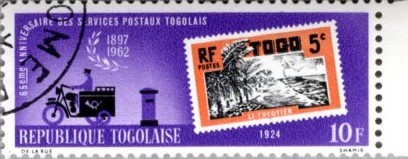
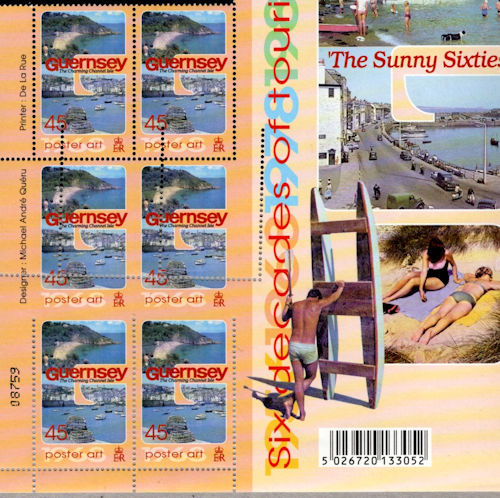
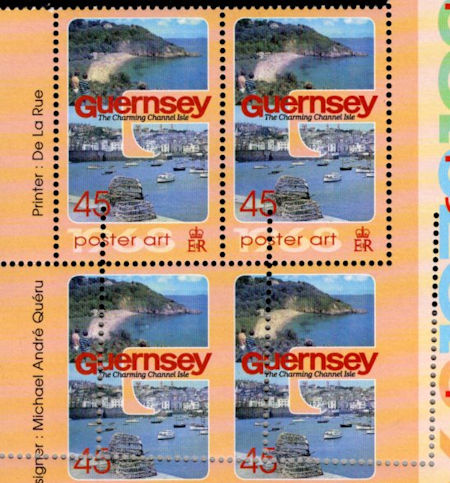
De la Rue also printed stamps not only for Great Britain and its overseas territories, but also for other countries. Sometimes the printer's name can be found on the stamps. This is often found on the printer's sheet or in the sheet margin.
|
|
Detail of a sheet that clearly shows the name on the printer.
The mis-perforation is also visible. |
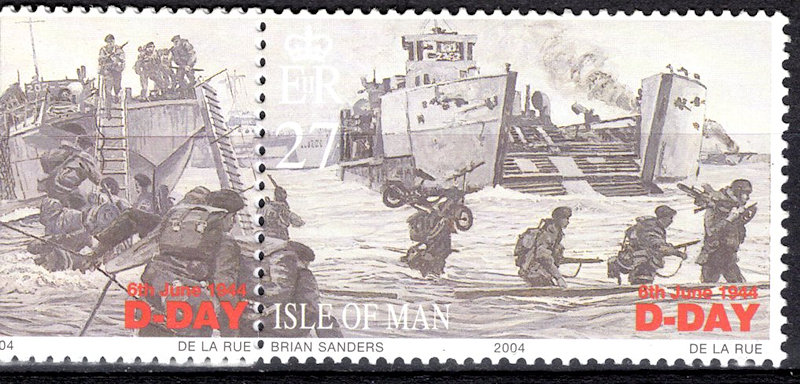
As collectors of motorcycle stamps, our primary interest lies in stamps featuring motorcycles. But sometimes it's interesting to learn more about the background of the stamp (or printing).
This article is a shortened version of the story by Cees Janssen at Postzegelblog (in Dutch) from 20 Juli 2022, with an addition related to motorcycle philately by Nico Helling
Top - Back to former page - Home |