Komusina franking machine
After the introduction of postage stamps, more and more people and businesses began sending mail. Businesses needed keep stamps of various denominations on stock. To prevent private use by employees, the stamps were provided with a perfin.
Perforated initials are company names or logos that are punched into stamps. So, the holes in the stamps are not damage, but rather company initials to prevent theft (or personal use) by employees.
Stamps were legal tender for a long time after their introduction. Not only for pre-paying for the delivery of your letter, but also for things like paying for your bread at the bakery. It was even possible to exchange stamps for cash at the post office. For the mostly low-paid employees of companies, this was a nice way to supplement their salaries. To counter this, companies requested, and were granted, permission to perforate the stamps with company initials or a logo. For a long time, these perfins were considered damaged and discarded, but today they are considered an asset, particularly in thematic collections.
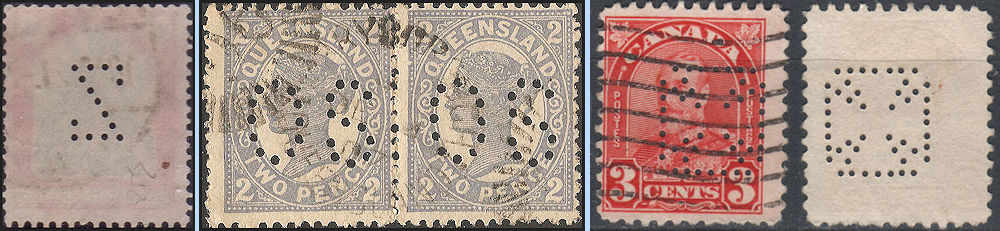
From left to right: perfins from Zündapp (Germany), Official perfin (OS) and perfin in shape of a logo
It took increasingly long to stamp and postmark the growing volume of mail. The franking machine, which could stamp the mail with the postage value and date, was therefore a blessing, especially if different rates could be printed with the same machine.
The first tests with franking machines were conducted in Norway and they were put into service in 1903.
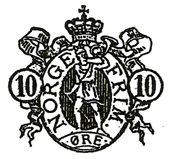
The Netherlands followed in 1925, when the use of franking machines outside the post office was also permitted. The first franking machine here, from Universal Postal Franking Machines (UPF), was imported and installed by NV Ruys Handelsvereniging in Rotterdam. The first postmark from this company appeared on September 7, 1925.
Some time later, the UPFs were replaced by the more familiar Francotype franking machines.
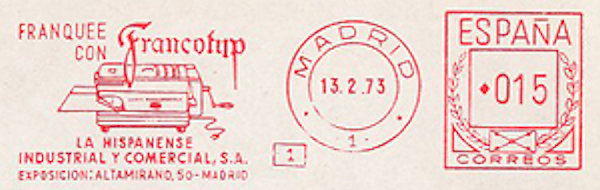
The franking stamp consisted of three parts. On the right, a value stamp (tariff), in the middle a date stamp (date and place), and on the left, a flag (advertisement). Sometimes the right and middle parts were reversed. The value and date stamps had to be red, and the flag could be a different color. Not every country adhered strictly to this.
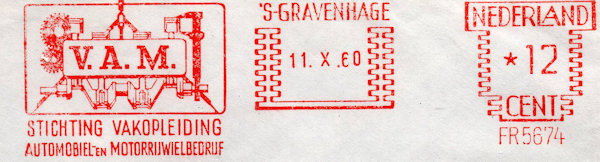
FR = Francotype stamping
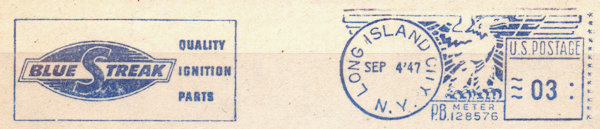
PB = Pitney Bolae stamping
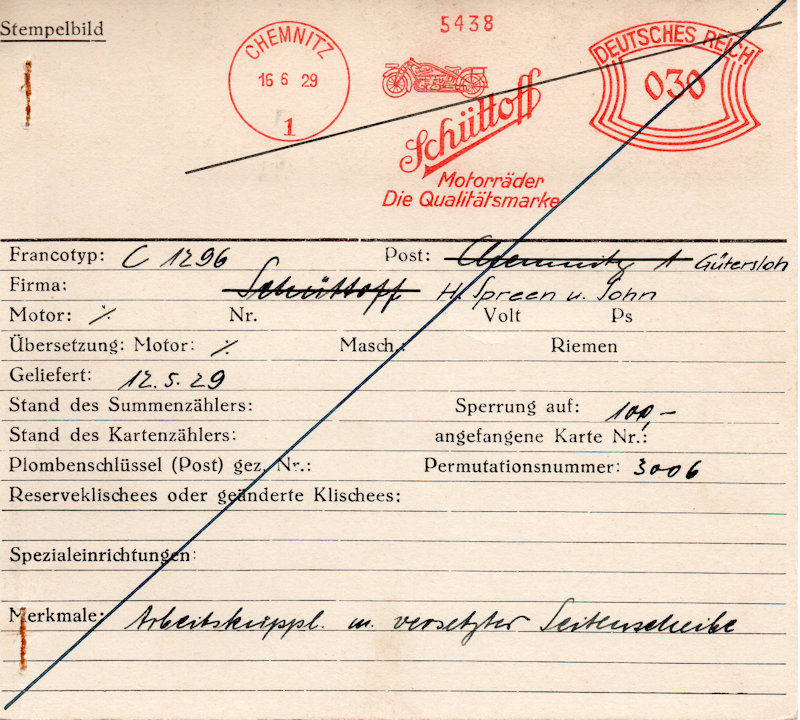
Each machine was provided with its own unique registration card (in German: Musterkarte) containing the machine's details along with a sample stamp imprint. If the layout of any of these sections changed, this was noted on the registration card, as were maintenance intervals.
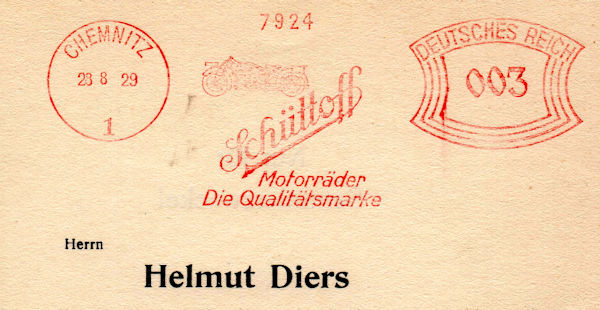
Paying postage with a franking machine provided a discount for businesses. The flag was mostly also in red because otherwise the cost of an additional ink color would negate the discount.
Postage could be settled with the Post Office in two ways: upfront, by purchasing a value card from the Post Office that was inserted into the machine, or by payment afterward. Each franking machine had a counting mechanism, and once a month the difference between the beginning and ending counter reading had to be settled. Franking machines evolved into integrated weighing and franking machines, with the advertising element, the flag, more and more being eliminated. This was a pity, because franking machine stamps with images for each thematic collection could be found.
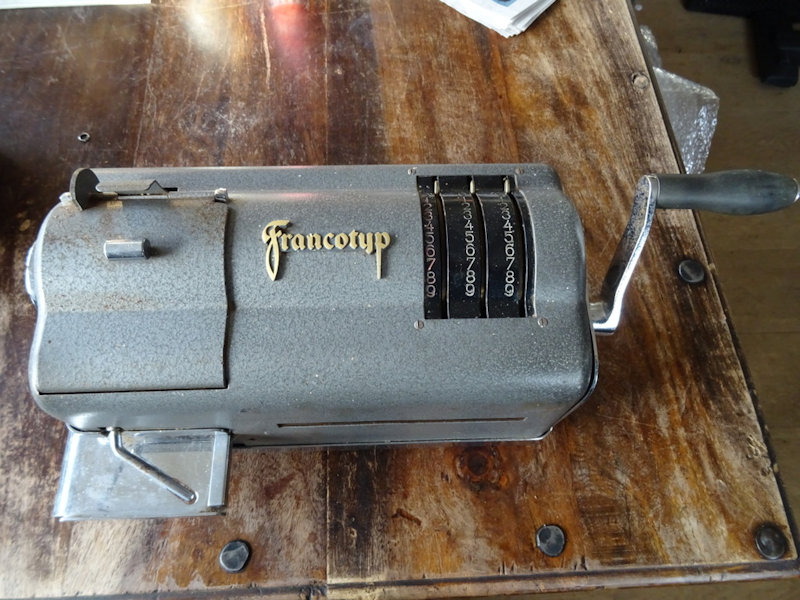
A disadvantage of these franking machines was that their size made them limited to fixed locations.
If a company employed representatives to visit customers within the country, they could not send stamped letters or orders to the head office.
In Germany, Erik Komusin began experimenting with franking machines around 1915. His stamp pasting machine became available around the 1930s. The first stamp pasting machine was put into service in 1935. This franking machine was so compact that it was ideal for sales representatives visiting customers. After their visit, they could send an order or comment to the head office.
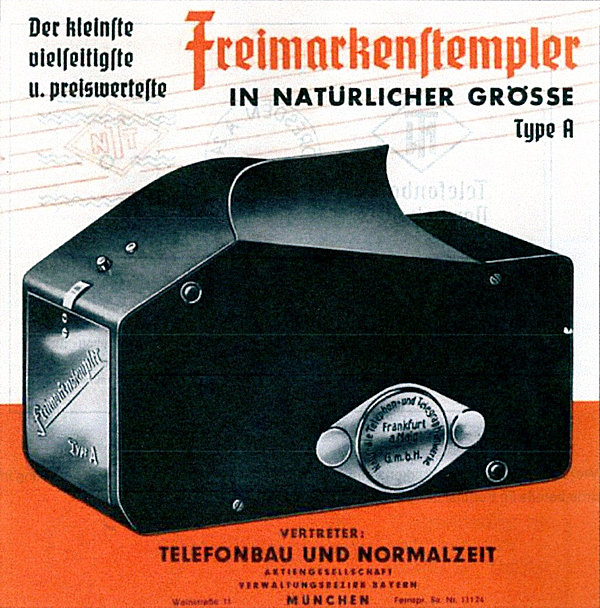
The stamp pasting machine contained a cassette containing a roll of stamps at a specific, current rate. Each machine had its own number, and after being issued to a company, this number was recorded in a logbook.
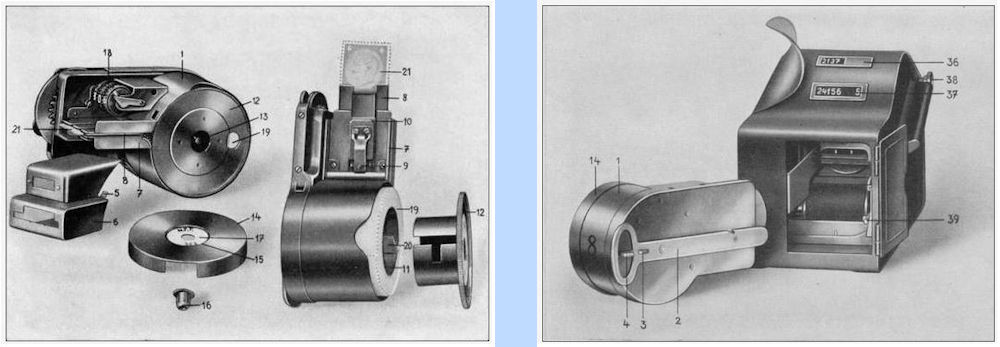
The image on the left shows the cassette that holds the roll of stamps. On the right, the filled cassette
is placed in the holder containing the advertising and date mechanisms.
How did this stamp pasting machine work? When the letter or order form was ready to be mailed, the user placed the device on the letter and slid it forward. During this movement, the stamp was pulled forward by four pins and rotated a quarter turn. After moistening it, it was cut off and pasted onto the letter. All of this took place in this small franking machine. The date and advertisment were also added to the letter during this process.
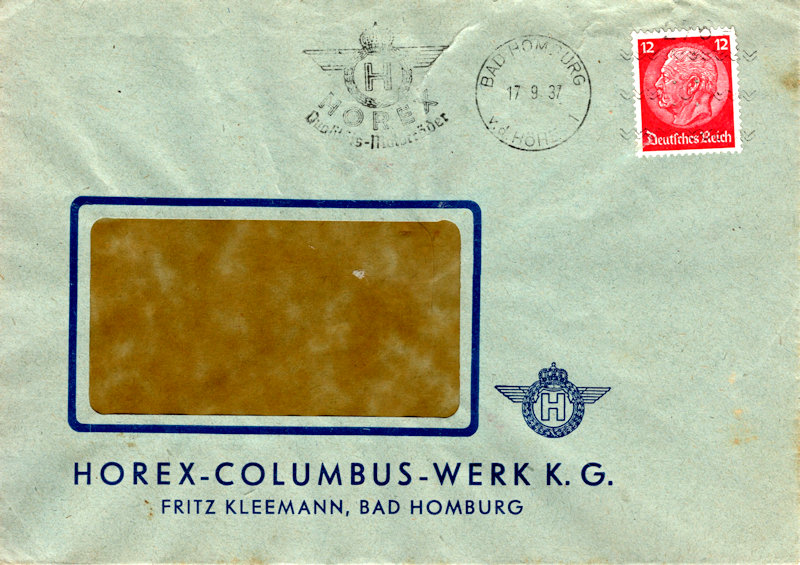
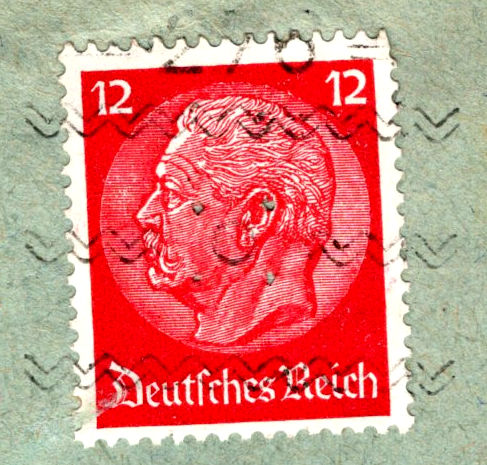
The stamp enlarged. The characteristic O is clearly visible under the handle. Around it, in a square,
are four holes left by the four pins that pull the stamp forward. The machine number
is also visible in the stamp: number 276 is printed above Hindenburg's head.
It will come as no surprise that there were a few minor flaws in the Komusina stamp pasting machine. Here are some examples:
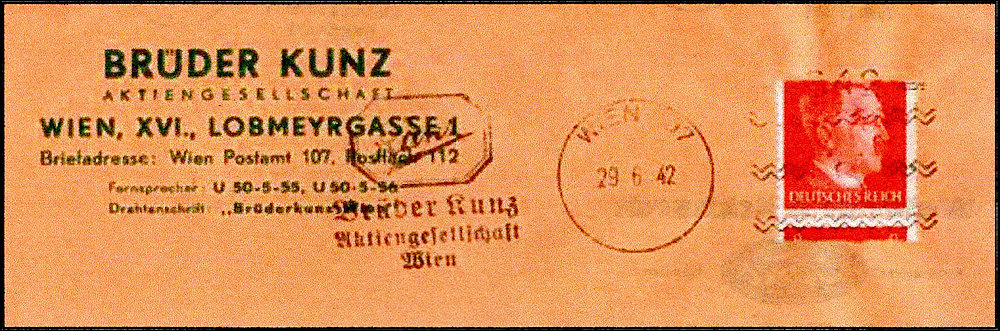
Cutting of the stamp was not on the perforation.
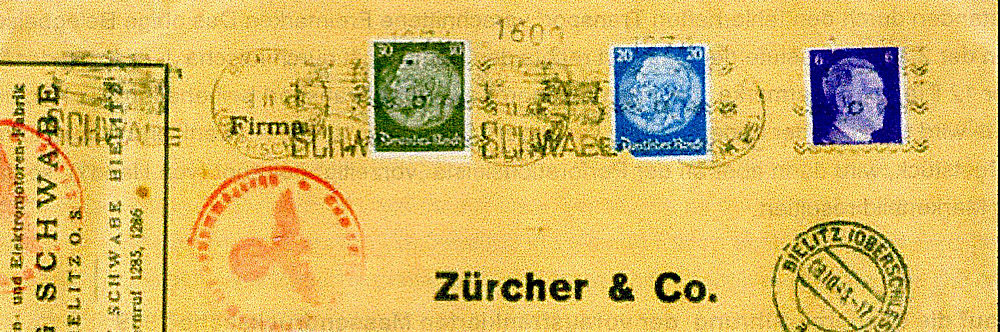
Multiple cancellations, because the stamp pasting machine was used multiple times
to apply different stamps to obtain the correct rate.
After the stamp pasting machine, Komusin also designed a standard franking machine. This one is very similar to the Francotype.
Here is a letter from the Nürnberger - Hercules - Werke A.G. from Nürnberg.
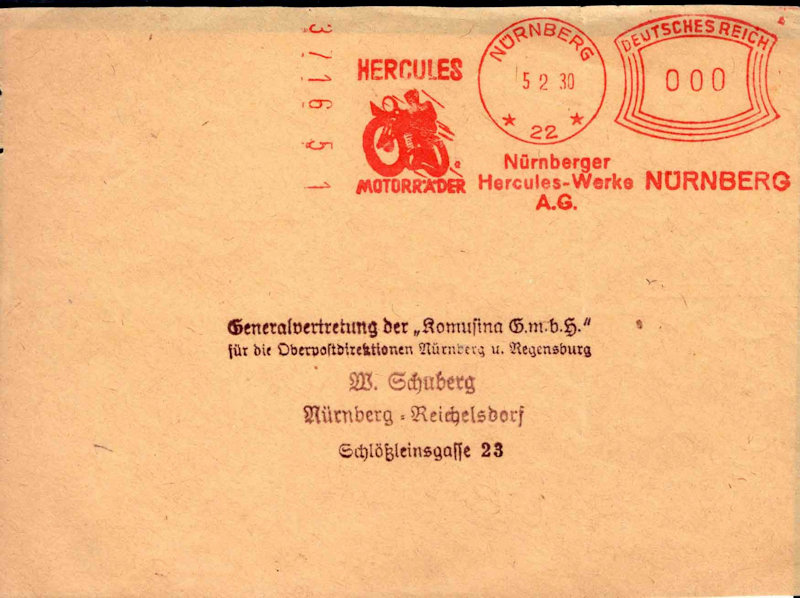
This letter raises some questions. The letter is from Generalvertretung der Komusina GmbH (general agency from Komusina GmbH) and addressed to Oberpost-Direktionen (postal directorate) Nürnberg and Regensburg. However, there is no postage value on the postmark. It is a so-called zero postage.
To use this in an exhibition, it is necessary to demonstrate that it is a proof, or that it has been used postally. It is not a proof, as the "Specimen" or "Probe" designation is missing. Was it used postally then? After consulting with various specialists, my conclusion is that this letter or card was used to report an interim reading from the franking machine to the post office, in order to settle the postage costs. The current total postage amount is shown vertically on the left side of the Komusina postmark. It is 3716.51 Reichsmarks. If the reading from the previous report is deducted at the post office, the amount to be settled is known.
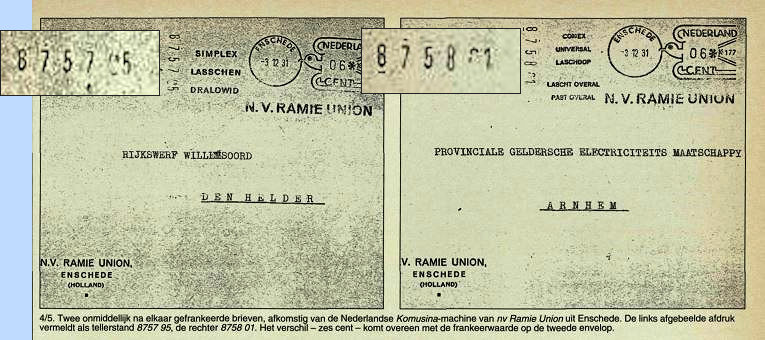
These two stamped envelopes demonstrate that this is indeed the total postage. The total amount for the letter on the left is 8757.95 marks. The postage is 0.06 marks. The total amount for the letter on the right is 8758.01 marks: the previous amount plus postage.
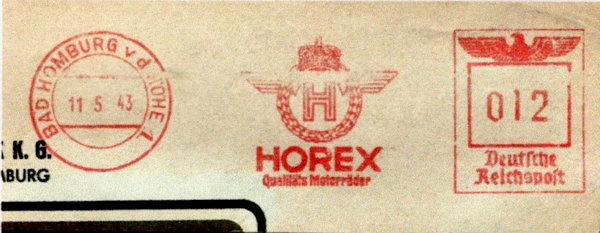
When Erik Komusin went bankrupt, Francotyp took over the company and replaced the Komusina machines with their own Francotyp machines. The stamp was also changed. Below is the Horex stamp from the Francotype machine.
Nico Helling
Top - Back to former page - Home |