British Overseas Territories (BOT) - part 2
The boat is happily steaming towards the South Pole, and we're making a slight bend towards Tierra del Fuego. On the way, we pass the Falkland Islands, leaving South Georgia and British Antarctic Territory to our left (they don't have any motor philately to discuss anyway) to cross the Strait of Magellan into Chile and reach the Pacific Ocean. Halfway to our destination, we spot the statues on Easter Island, but this isn't a BOT country (and besides, they don't have any motorcycle philately), and we still have just under 2,000 km of the 5,600 km from Chile to cover before reaching our next stop.
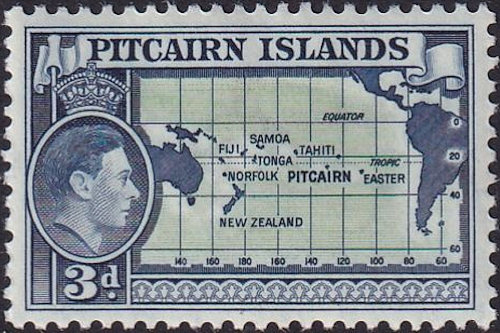
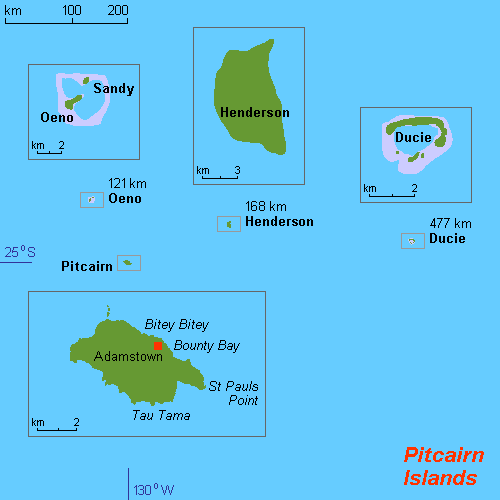
The Pitcairn Islands are volcanic islands in the South Pacific, and constitute the only British overseas territory in the Pacific Ocean.
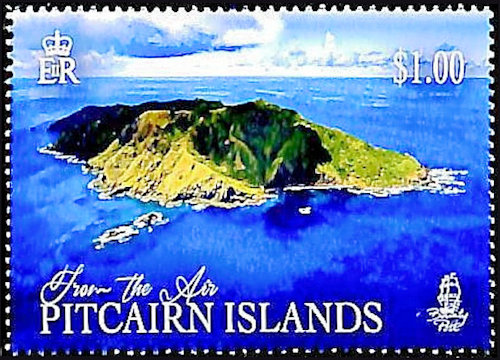
The four islands – Pitcairn (the only inhabited island), Henderson, Ducie and Oeno – are scattered across several hundred square kilometres of ocean and have a combined land area of just 47 square kilometres. Henderson Island accounts for 86% of this figure, but is hardly accessible. And so the tiny Pitcairn with its 4.5 km², provides in Adamstown, the archipelago's capital, a home for all the inhabitants of the island group.
The first inhabitants of the archipelago were from the Polynesian civilisation, probably originating from Mangareva, some 490 km to the north-west. The name Pitcairn comes from the son of a certain Major Pitcairn of the Royal Navy, who named the main island after his father.
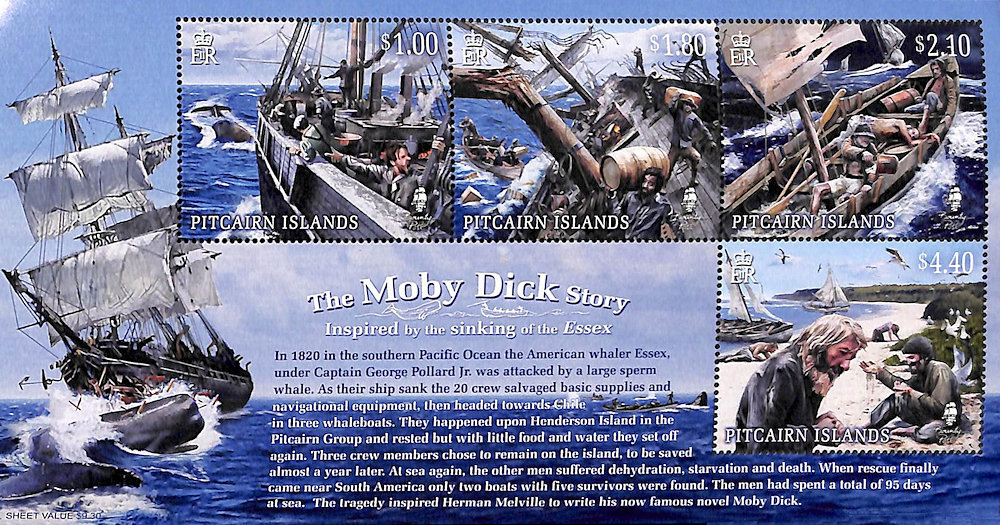
Some of us, upon hearing the name Pitcairn, probably have memories of the book "Moby Dick".
But almost everyone is familiar with the story from the book (written by John Barrow) and the film: Mutiny on the Bounty, in which, in 1789, a mutiny broke out on the ship the Bounty under the leadership of Fletcher Christian. Captain Bligh was cast adrift.
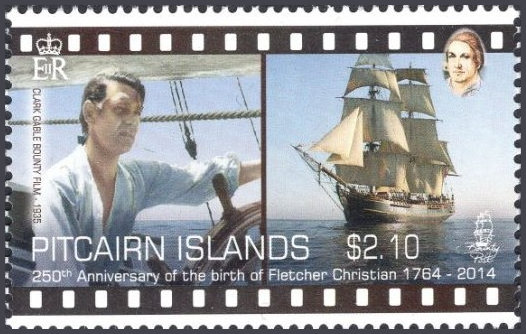
The mutinous crew of the Bounty caused the population to rise to 28, but following various conflicts with the original inhabitants and amongst the mutineers themselves, this number was reduced to one man and a number of women. The man's name: John Adams. As the sole man, he gave his name to what is still the second-smallest capital city in the world: Adamstown. John is described as "the Father of Pitcairn". The name of the ship, Bounty, can also be found everywhere on the island. According to the latest figures (2023), 35 people live on the island.
For us motorcycle stamp collectors, the Pitcairn adventure began with the issue of a series of 13 postage stamps on 12 September 1977, featuring scenes typical of the island.
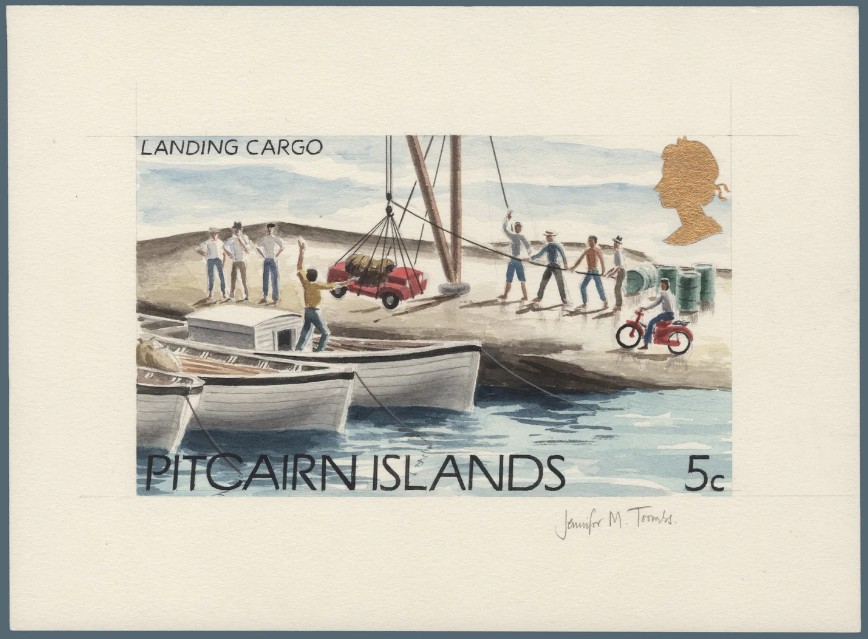
On the 5-cent stamp, we see supplies delivered by larger ships being unloaded from Bell-Long Boats at Harbour Quay in Bounty Bay. A curious motorcyclist watches the unloading of a Jeep with interest, shown here on a proof print.
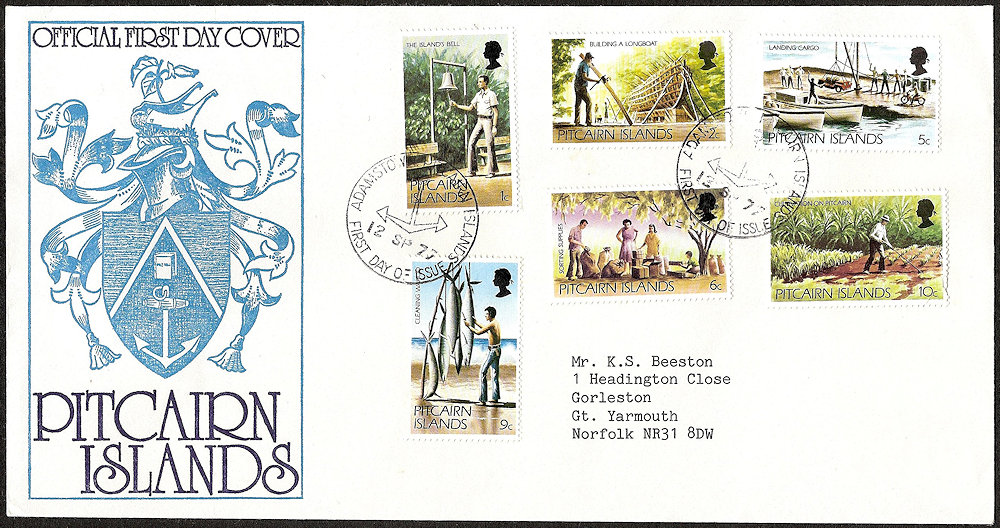
The stamp on the left shows the famous bell that must be rung when the supply ship arrived.
14 years later, on 25 September 1991, the second series of Pitcairn Islands stamps of interest to us was issued. A series of four diamond-shaped stamps featuring modes of transport on the island. Goods were transported from the harbour to their destination using large wheelbarrows, pushed along paths made slippery by the rain. To prevent slipping on the steep roads, the wheelbarrows had runners instead of legs, as shown on the FDC.
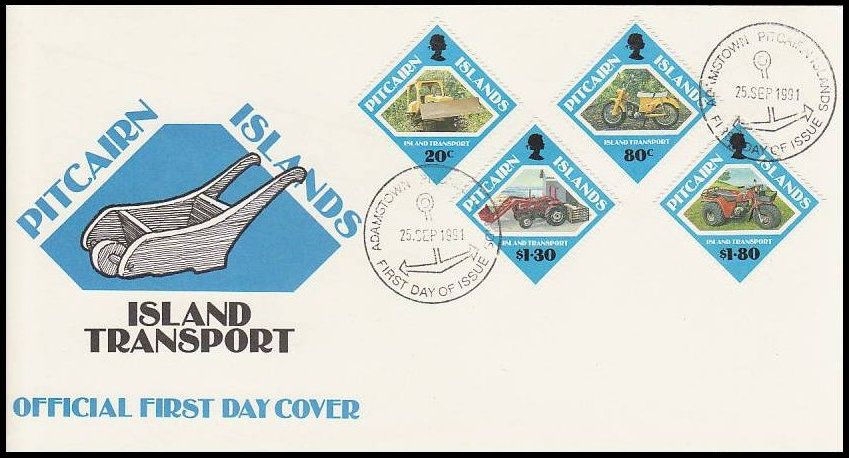
Two of the stamps depict a vehicle that is useful for our collection. The 80 ct samp features a yellow Honda 90cc motorbike.
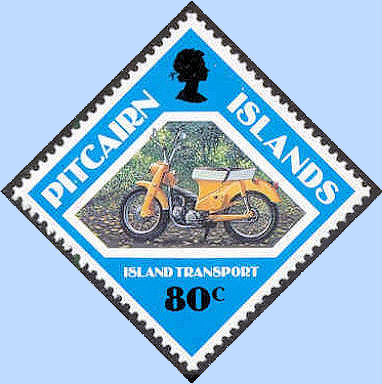
The C90, better known as the Super Cub, was often used to transport two or three passengers at a time, driven by a rider, to higher ground along the unpaved roads. Dusty in dry weather, and muddy when it rained. The Hondas were also used to carry goods, with loads piled high on the back. In total, there were around 34 of these little motorbikes in use on the island by the mid-1970s.
In 1969, transport using Mini Mokes was tried.
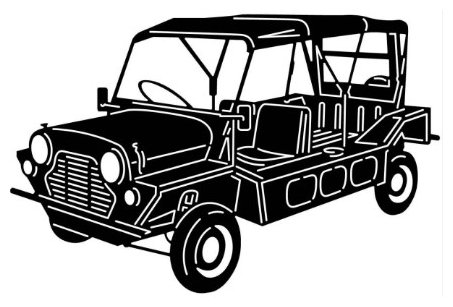
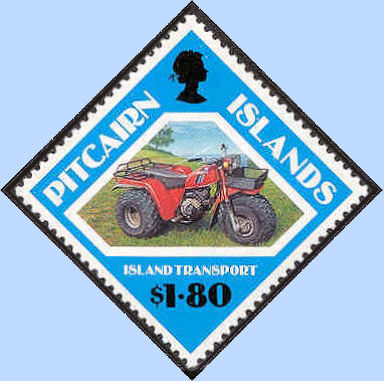
However, these small cars were unable to cope with the steep roads, and when trikes and quads came along, people quickly opted for these multi-wheeled motorcycles. They had no trouble with the mud and could carry heavier loads and multiple passengers. The $1.80 stamp features a Honda ATC 200E Big Red.
We will see quads again in the next Pitcairn series.
The other two stamps in this series feature a Caterpillar D4E bulldozer (20 cents) and a Massey Ferguson 245 tractor, purchased in 1979, on the $1.30 stamp.
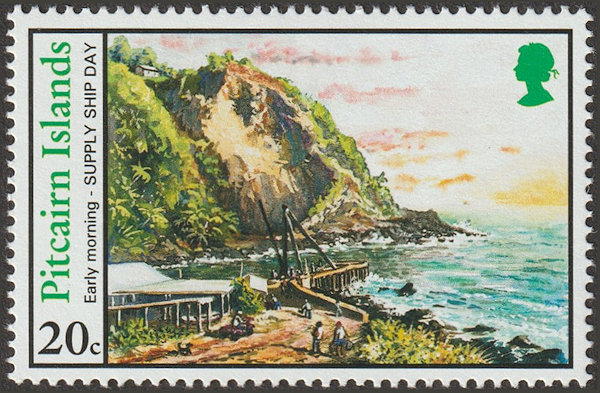
Twice a year (in January and November), a ship sails to the island carrying passengers and essential cargo. People look out for the boat early in the morning. The ship drops anchor outside the mini-harbour, and visitors and cargo are ferried to the small harbour basin in small boats.
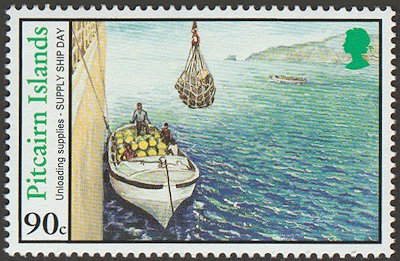
This day is called "supply ship day". The 20 cents stamp, issued on 30 January 1996, offers a view on the bay, harbour and quay with a quad and approaching islanders.
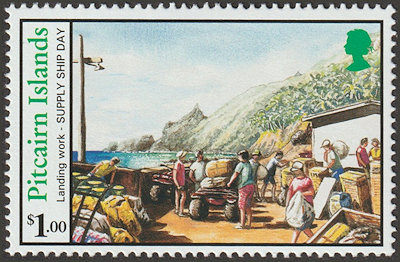
The $ 1.00 stamp clearly illustrates why the quad is the workhorse over there. One is fully loaded waiting to commence the journey to the capital Adamstown, 150 meter higher up.
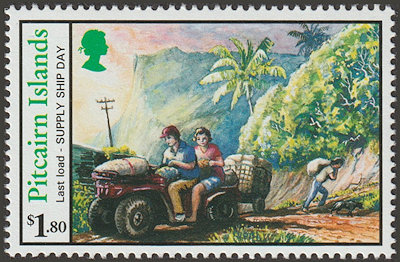
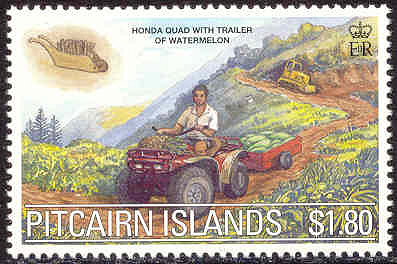
The last and highest-value stamp ($1.80) of the six features yet another fully loaded quad bike with a trailer, affectionately known as "the last load". The Honda's thus make life on the island a little easier.
Beekeeping, and consequently the production of honey, is one of the main sources of income on Pitcairn. The honey is of excellent quality and is exported all over the world, but mainly to New Zealand. It is therefore not surprising that these activities can be found in several stamp series.
On 12 September 1999, the Post Office issued a series of four self-adhesive hexagonal stamps printed by Southern Colour Print (NZ). This is Pitcairn's first series of self-adhesive and hexagonal stamps. The theme is beekeeping on the island and the bee species used, Apis Mellifera Ligustica. A friendly species that produces clear honey with a long shelf life.
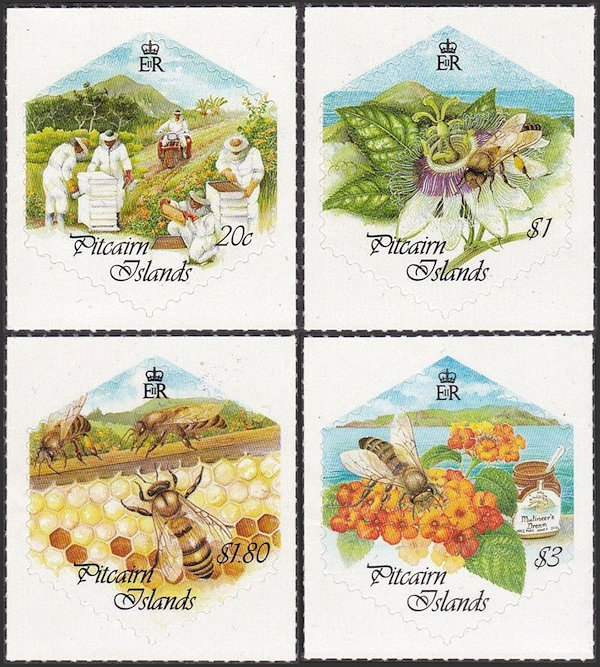
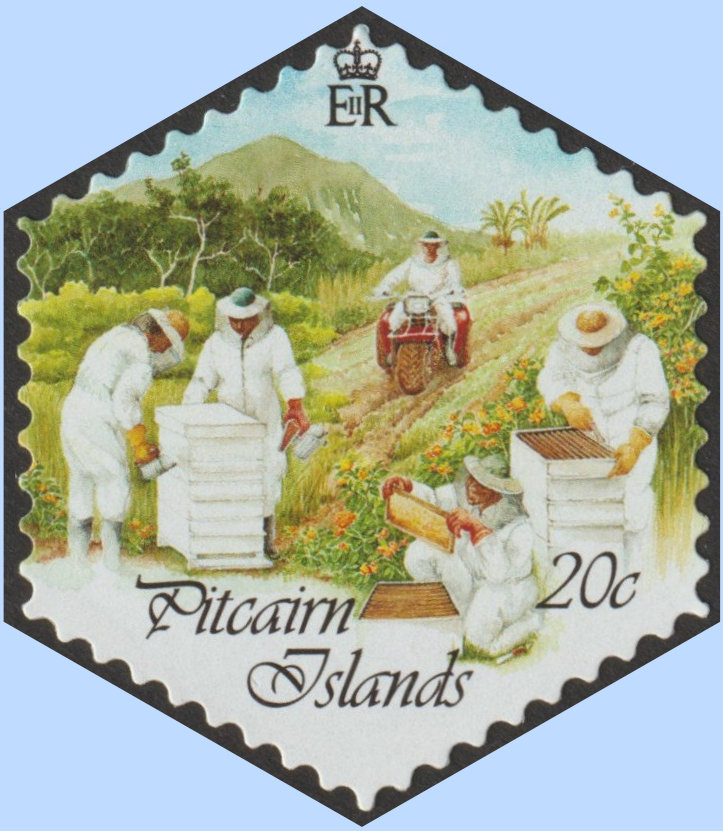
For us the first stamp in the series, the 20-cent one, is the most valuable. It shows a group of beekeepers standing by two beehives, whilst a beekeeper approaches on a motorised three-wheeler, the aforementioned Honda Big Red ATV.
Less than a year later a series was issued to mark the turn of the century, with the theme "Communication". This is the third series celebrating the turn of the century, and it focuses primarily on the modernisation of transport, both on the roads and in the digital realm. On 7 July 2000, a range of stamps was issued, including a $1.80 stamp featuring a Honda quad bike with a trailer, loaded with watermelons, alongside the wheelbarrow with runners that was used in the old days.
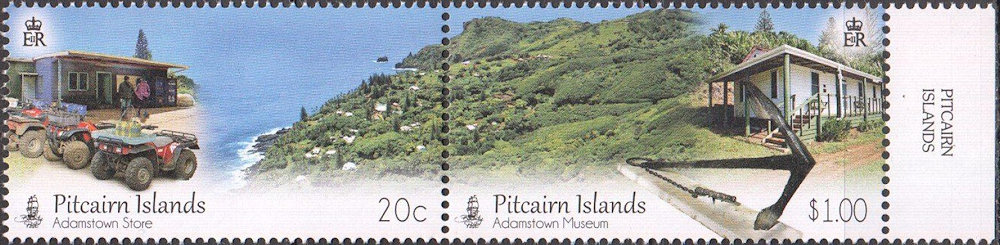
Although trade is mainly conducted amongst the residents themselves, there is also a proper shop for the 35 inhabitants of the capital, Adamstown. The stamp, which is currently the last one in our collection, offers a glimpse of this shop where, unsurprisingly, the Honda quads – widely used as a means of transport – are parked outside. This stamp is part of a series of four, issued on 24 August 2016. They are connected horizontally in two pairs of two. The left-hand stamp in the pair features the aforementioned shop, and the right-hand one the "large" Island Museum. In the centre, spanning both stamps, is a view of Adamstown.
Well, that’s all for now on the Pitcairn Islands in the Pacific Ocean.
From here, we are sailing towards Panama to pass through the canal into the Pacific region, where we'll visit the Cayman Islands, the Turks and Caicos, Bermuda and the group of islands comprising Montserrat, the Virgin Islands and Anguilla next time.
Hans de Kloet
Top - Back to former page - Home |