Puch
In 1899, the Slovenian Johann Puch (Slovene: Janez Puh) founded the Styria bicycle factory.
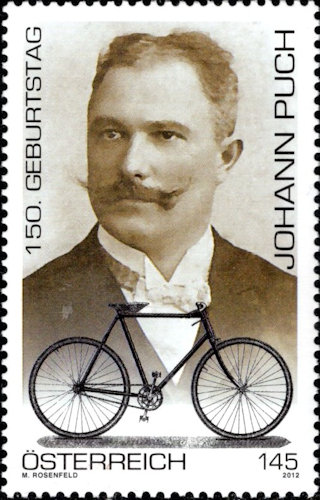
Whilst the bicycle factory continued to operate, the first 2¾ hp inlet-over-exhaust motorcycles were built at a new Puch factory in 1903.
Over the years, the Puch company has gone by many names. A few of these are listed below. Upon its foundation, the company was called Johann Puch, Erste Steiermärkische Fahrrad-Fabrik AG, Graz. This was later changed to Vereinigten Styria-Fahrradwerk und Dürkopp-Werke AG. In 1909, it merged with Austro-Daimler, which in turn had links to the Steyr car factory.
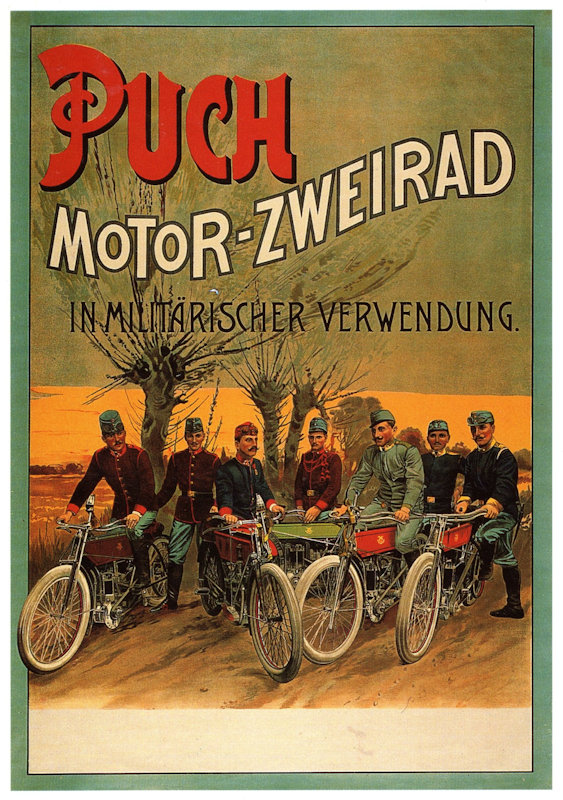
In 1904, the company began manufacturing cars, which became so important that motorcycle production came to a halt in 1917. During the First World War, Puch supplied simple 254cc and 308cc single-speed, belt-driven motorcycles to the Austrian army, both fitted with Puch’s own single-cylinder side-valve engines.
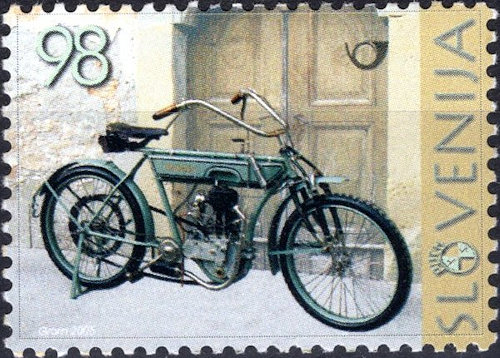
Experiments were carried out with gearbox options for the larger model, but it is unclear how many of these motorcycles were commercially produced for use by the Austrian army.
In 1923 Giovanni Marcellino was recruited, an Italian engineer and fan of double-piston engines. His motorcycles proved so successful that now the car production was subsequently halted. A double-piston engine developed by Marcellino in 1923 remained in production until the 1960s. In the early 1930s, the company's name was changed to Steyr-Daimler-Puch AG, and from that time onwards, cars and tractors were also manufactured.
Puch became quite successful with its motocross and enduro models, as well as its mopeds.
From 1931 onwards, smooth-running 496cc vertical twin-cylinder two-stroke engines with four pistons were produced in various versions.
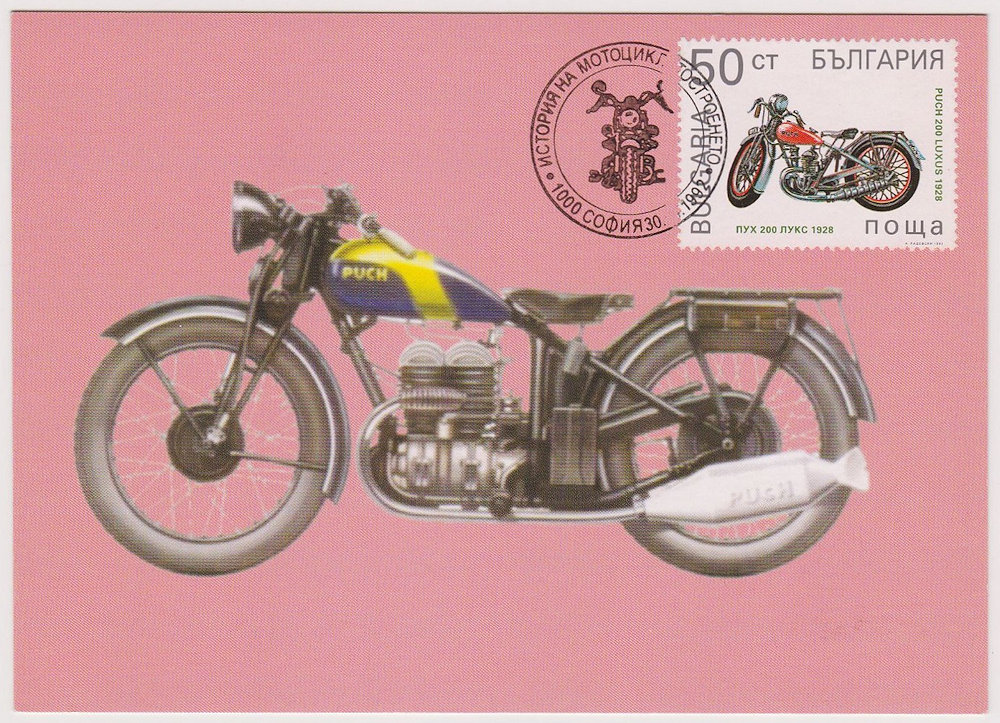
Maximum card: as much as possible resemblance between card, stamp and postmark
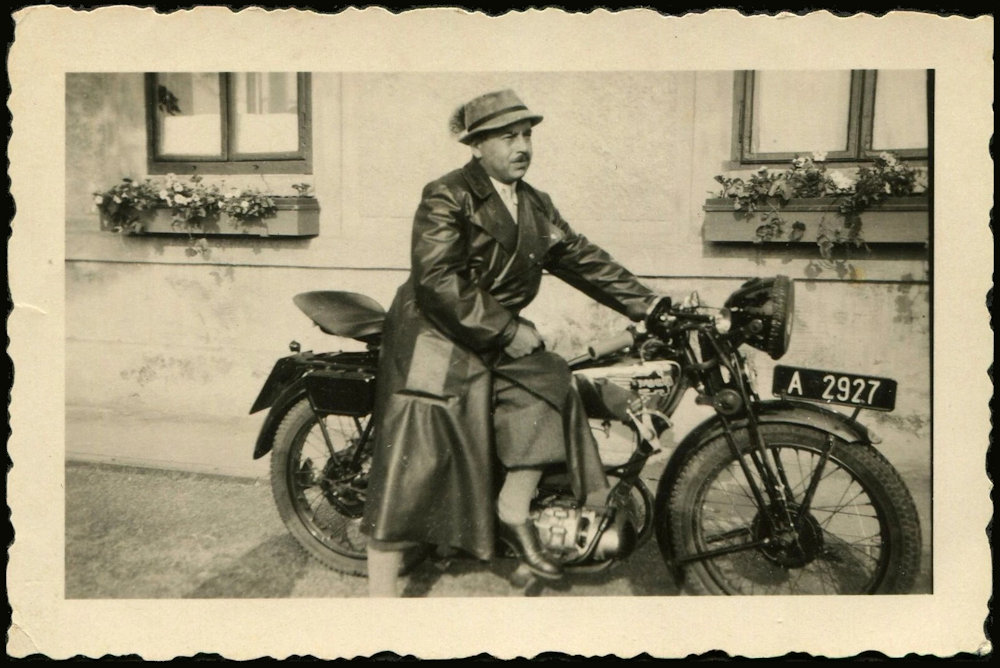
In 1938, when Austria became part of Germany, the company was renamed Hermann Göring Werke. Although a number of side-valve boxer engines were produced just before the Second World War, the company returned to two-stroke engines after the war.
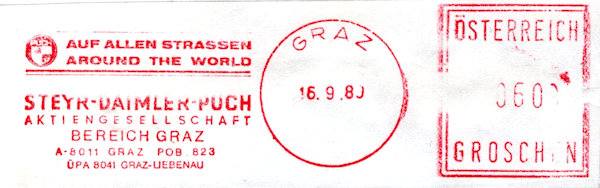
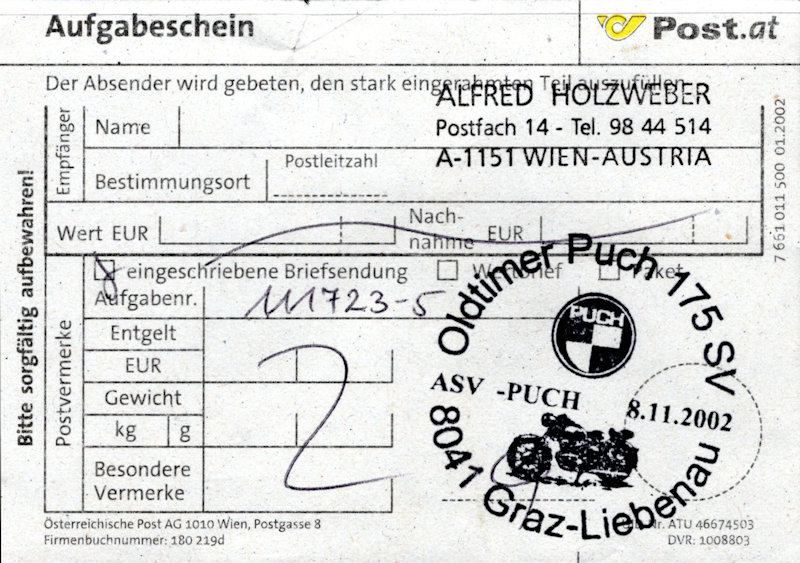
It was not only complete motorcycles that left the factory. The parts needed to replace broken ones had to be sent to the dealers. This was done via the postal services, for which a dispatch note had to be completed.
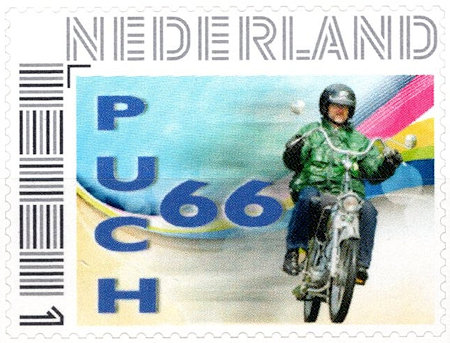
In the Netherlands, Puch is best known for its distinctive mopeds, which were particularly popular in the 1960s. The original model was the MS 50, which appeared in the Netherlands in 1954 and was later given the name Baby Puch, partly because of its small fuel tank. This moped was very modern for its time, featuring telescopic suspension and a forced-cooling engine, amongst other things. It cost 650 guilders, which was a lot of money. This model had an easy, low step-through frame for women wearing skirts.
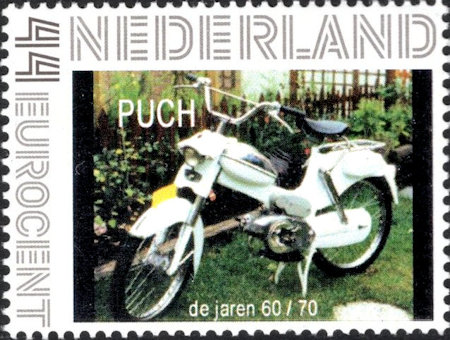
As the economy improved, mopeds became increasingly affordable for more and more young people. It were the "Kikkers", a gang of Teddy boys from The Hague, who were the first to realise that this Puch "ladies moped" could with a few modifications also serve as a men's moped.
In the late 1960s, Puch was joined by the new, somewhat simpler and therefore cheaper cult brand Tomos.
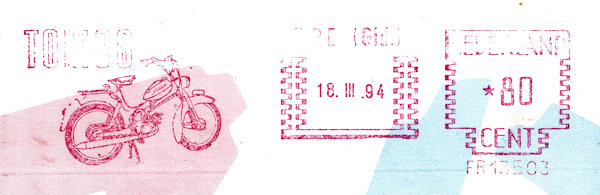
The Tomos had a larger headlight, wider mudguards and no toolboxes. To true Puch enthusiasts, the Tomos was a knock-off. However, the Tomos frame was said to be stronger than that of the Puch, which was notorious for its tendency to warp, particularly in tuned versions. As a result, Tomos frames were sometimes fitted with Puch engines. Puch remained popular in the 1970s and early 1980s with the MV50 and Maxi models, but the MV50 and Skytrack disappeared from the Puch moped range around 1983. In contrast, the Puch Maxi, produced from 1969, remained in production until mid-1990. The Puch moped factory was taken over by the Italian company Piaggio in 1989. From that point on, production was also transferred from Graz to Italy.
In the late 1980s and early 1990s, there was a major revival of the MV50 and Skytrack models in the Netherlands with the establishment of the PTCN (Puch and Tomos Club Netherlands) and Den Haagschen Puch. Today, there are countless Puch clubs active throughout the country. Among other events, the annual Puch and Tomos meeting "Kouwe Klauwe" (cold claw) is organised in Scheveningen.
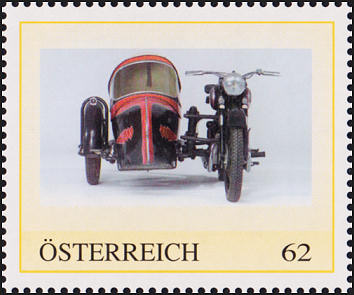
Austrian Post AG issued, among other items, the stamp and first-day cover shown here on 13 February 2026.
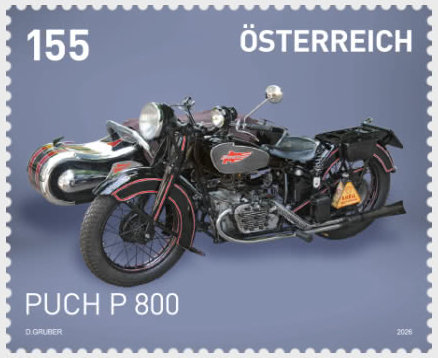
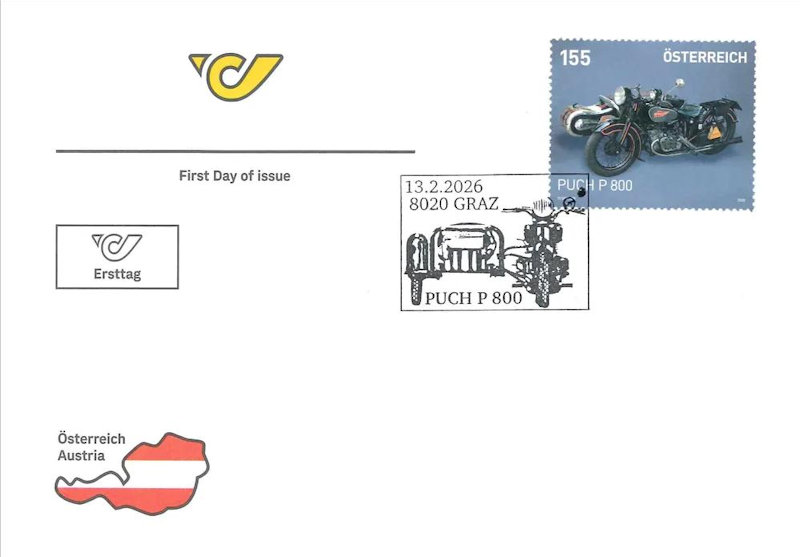
The Puch P800 was the most powerful Puch motorcycle, and was also ideally suited for use with a sidecar. Puch was once Austria's best-selling motorcycle brand.
The Puch P800 model was launched in 1936 by the long-established company, which had merged in the 1930s to form Steyr-Daimler-Puch AG. With its four-stroke four-cylinder side-valve engine – an ultra-wide "near-boxer" engine with a cylinder angle of 170°, a displacement of 792 cubic centimetres and 20 hp – the P800 was used as a sidecar motorcycle by the police, the army and other authorities. However, the annexation of Austria by Nazi Germany in 1938 brought an end to production of the P800.
The MP sidecar was produced by Max Porges, the largest manufacturer of sidecars in the interwar period. The streamlined "Schlapfen" sidecar, with its enclosed mudguard, was particularly elegant.
Nico Helling
Sources (in Dutch):
· KNBF Newsletter 190
· www.puch66.nl/artikelen/geschiedenis-puch
· nl.wikipedia.org/wiki/Puch
Top - Back to former page - Home |