Third part British Overseas Territories (BOT)
To get from the Pacific Ocean to the Caribbean, we pass through the 80 km long Panama Canal, with a height difference of 26 meters. For this we pass, pulled by small trains, the three immense lock complexes to steam into the Caribbean part of the Atlantic Ocean at Colon. And although the oceans are in open connection with each other, the average water level there is slightly more than one meter higher, depending on the phase of the moon.
We set course north, towards Cuba. On our way, we pass the Cayman Islands.
Columbus spotted the islands during his fourth voyage of discovery and named them Las Tortugas because of the large numbers of turtles.
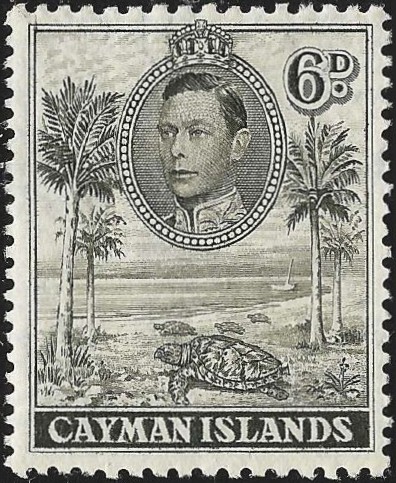
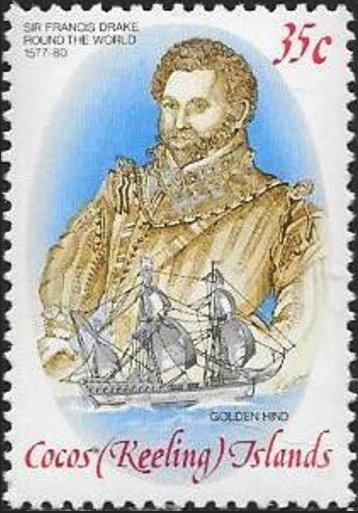
Later, this name was changed to Los Lagartos, after the large colony of lizards and iguanas that lived there. It was Sir Francis Drake who, in 1586, became the first Englishman to set foot on the island and mistook the iguanas and lizards for crocodiles, and therefore used the free translation Cayman Island. In 1670, England annexed the islands and Jamaica to Great Britain.
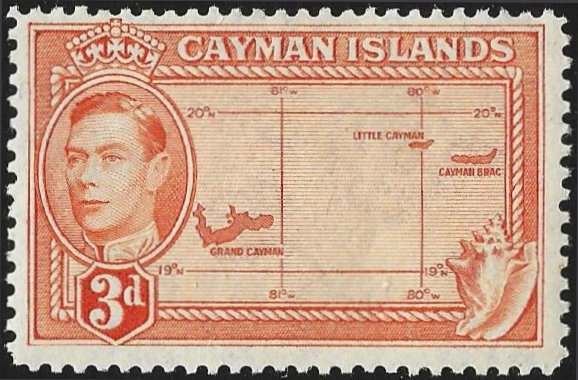
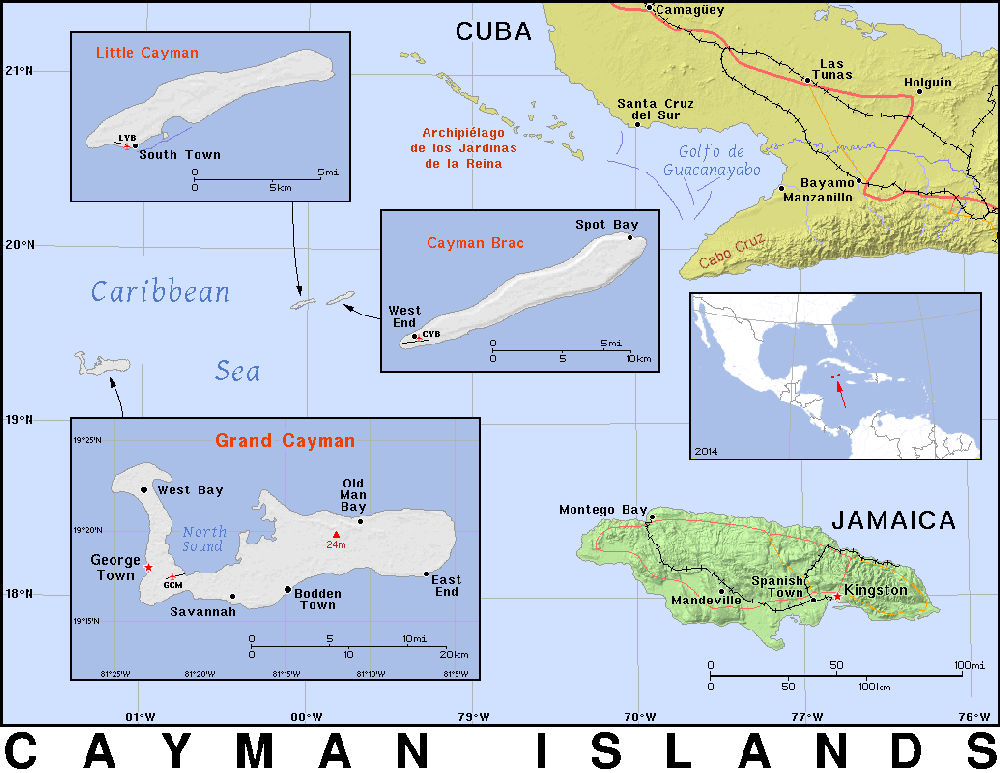
The country Cayman Islands consists of three islands: Grand Cayman (well, grand... the island measures 35 by 15 km, including a large bay), Little Cayman and Cayman Brac, both of which are narrow and elongated. Grand Cayman is home to the capital George Town with 47,000 inhabitants. The city thus claims the title of "largest city of all B.O.T. cities".
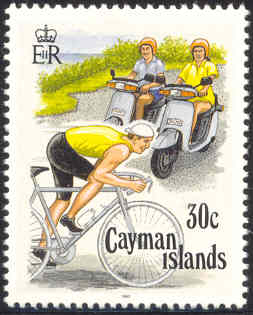
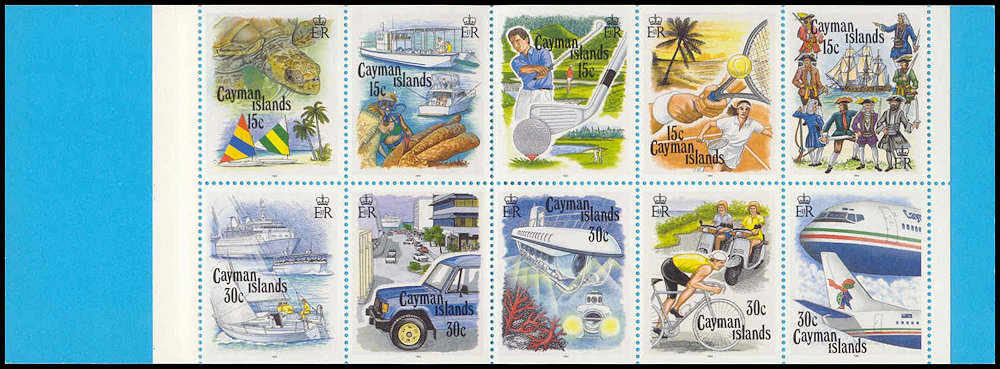
For us motorcycle stamp collectors the islands became interesting in 1993, as on September 30 a series of 10 stamps was issued to promote tourism. On a 30-cent stamp, we see a cyclist and two scooter riders. The series includes two different values: five 15-cent stamps and five 30-cent stamps. Each stamp features one of the ten images, and the stamps were printed in sheets with strips of five of the same value.
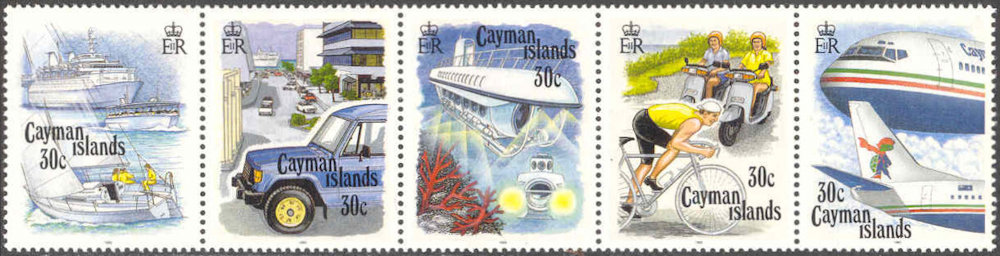
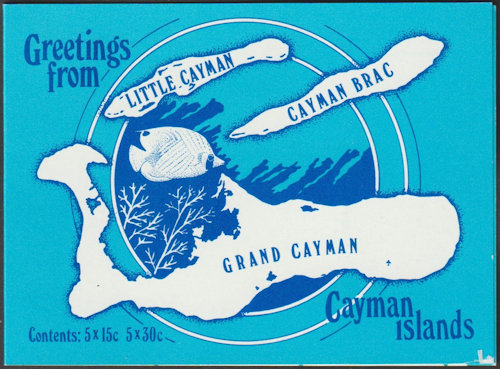
The series has also been issued in a stamp booklet. The stamps from this booklet can be identified by one unperforated side, either at the top or bottom. In the case of our stamp, that is at the bottom.
On March 15, 2000, the local Cayman Islands Postal Service commissioned CASCO (formerly Crown Agents Stamp Company) to issue a block of stamps showing the television characters from Sesame Street.
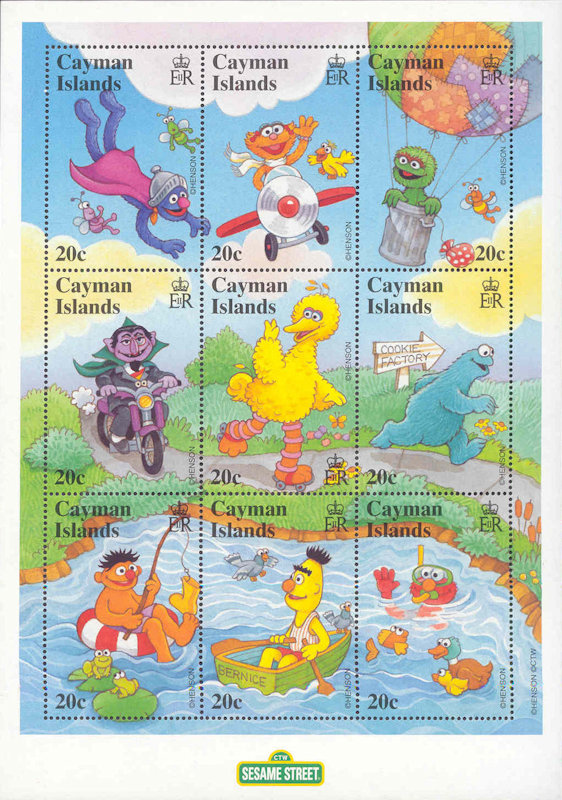
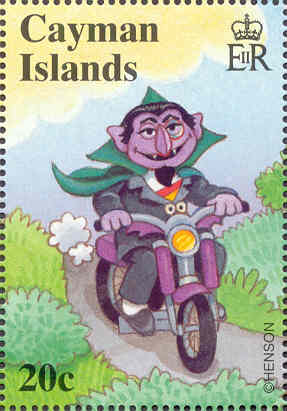
Among the nine main characters in the series is Count von Count, with his vampire appearance, depicted on a motorcycle. He was intended as a parody of Bela Lugosi's interpretation of Count Dracula. He first appeared in the show in the season 4 premiere in 1972, where he counted blocks in a sketch with Bert and Ernie. The Count often counts to 10 with his Uncle One, and he is madly in love with Lady Two. He also has a car with license plate 12345678910, but no clue how his motorcycle's license plate counts...?
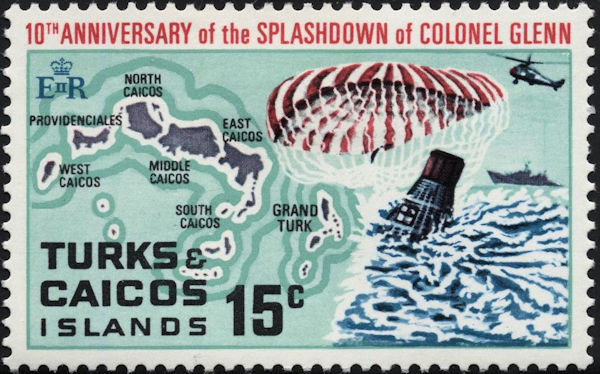
On the map, the following B.O.T. islands are referred to as the Turks and Caicos Islands. Going there we pass Cuba on our left side, and the island of Hispaniola, with the countries Haiti and the Dominican Republic, on the right.
Not far from the Bahamas lie some 300 small and slightly larger islands, together forming the Turks and Caicos Islands. The name of the archipelago is a combination of the two main island groups and has a botanical and indigenous origin. Turks: This part is named after the Melocactus, a local cactus species whose top resembles the Ottoman fez.
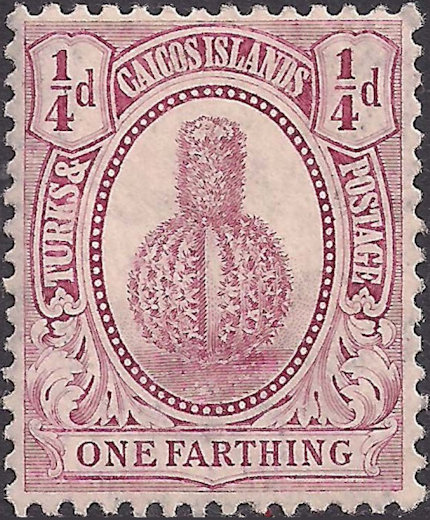
Caicos: This is derived from caya hico, a term from the language of the indigenous Taíno Indians, which simply means "chain of islands."
The islands have a turbulent history. For a long time, they were resting places for pirates, until they formed, together with the Bahamas and Jamaica, a single colony under the British Crown.
In 1848, the Turks and Caicos Islands decided to form a single administrative body. After Jamaica became an independent state, they came under the administration of the Bahamas. Since 1973, the Turks and Caicos Islands are a separate British Overseas Territory.
Together the Turks and Caicos Islands have around 47,000 inhabitants, of which the majority (around 22,500) lives on the island of Providenciales.
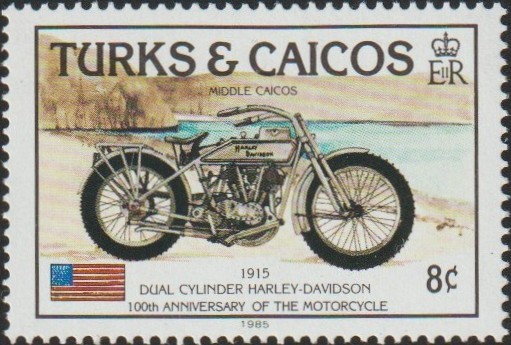
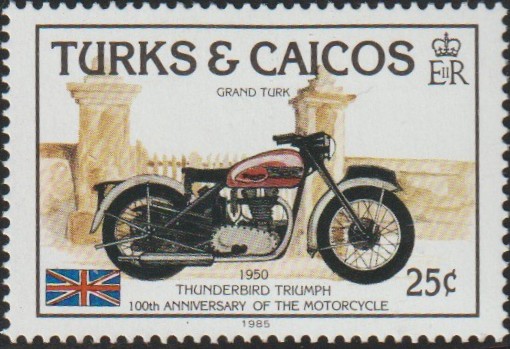
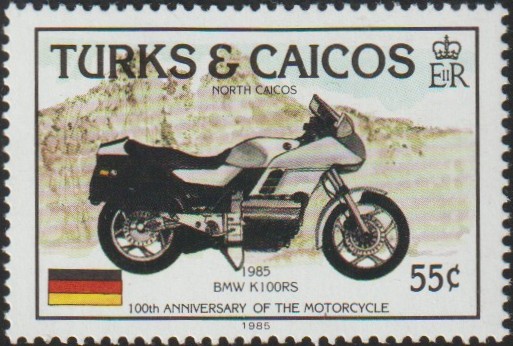
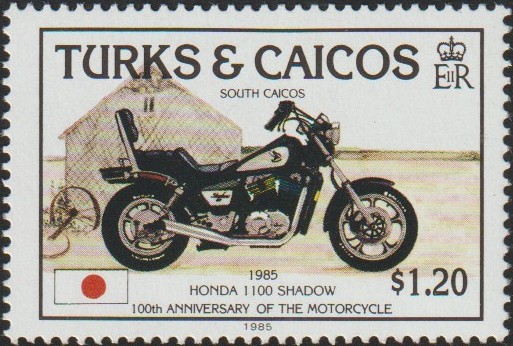
You can still find the regalia of Great Britain on the stamps of TCI, as the official abbreviation for the name of the islands is. This is also the case on the series from 1985 that is of interest to us: 100 Years of Motorcycles. A series of four stamps and a block, showing the major brands of today and yesterday.
On the 8-cent stamp, we find a two-cylinder Harley-Davidson: the 11-C (Civil) (two-speed gearbox) with 6 hp. The model, which shared the same appearance as the Silent Grey Fellow, underwent a total of 29 updates, the most important of which were a freewheel and a lower seat. In 1915, the 11-F (three-speed gearbox) with 11 hp and a top speed of 105 km/h was also released. The 11-F (Fast) was a stripped-down version of the Civil for racing.
In the background, an image of Central Caicos with Mudjin Harbour's cave beach.
The 25-cent stamp shows the 1950 Triumph Thunderbird (named after a mythical creature that lives among the clouds (Native American)). The Triumph 6T Thunderbird is an iconic British motorcycle that was introduced in 1949 and officially delivered from 1950. The 6T was designed for the American market and has more power. The motorcycle became world-famous when Marlon Brando rode it in The Wild One (1953). The parallel twin measures 649cc, delivers 34 hp, and has a four-speed gearbox. Originally, the bike was only supplied in light blue metallic, although other colors were produced after 1950 (also in red, as on the stamp??). In the background, a view of Grand Turk with the gate of St. Mary's Anglican Church in Cockburn Town (the capital).
The third stamp depicts the Flying Brick, or the BMW K100 RS. The K100 (without RS) was introduced in 1983. The K stood for Compact design (in German), and 100 indicated the number of cc's.
In 1984, a sporty version of the K100 was produced: the K100 RS (Reise Sport, or in English: Travel Sports) with two valves per cylinder, which later led to the actual name K100 RS 2V. The 1985 model shown on the stamp is already equipped with a bit more luxury, such as a windscreen/fairing and a luggage set.
In '89, a 4V version of the RS with 16 valves and full fairing also appeared: the K1.
One year later, the 4V engine was also used in the sport version of the RS, and its name thus became K 100 RS 4V.
The K series ushered in a new era for BMW, following the successful period with the /7-series boxer engines. In the background, a view of the coastal rocks of North Caicos.
The final stamp is reserved for the world's largest motorcycle manufacturer: Honda, with 20 million motorcycles per year (2024). The 1100 Shadow is shown. The Shadow series was introduced by Honda in 1983, starting with the VT 500 Shadow. Shadow was chosen as the series name because the motorcycles had a very low seat, causing them to cast more shadow than visible motorcycle when riding.
The VT 1100 Shadow (later "Classic") was introduced in 1985 as a counterpart to the Harley. VT stands for V-Twin. In the USA, the rule that imported motorcycles could not exceed 700cc was scrapped in early 1985.
Honda immediately brought a 750cc version of all 700 models to market. Our Cruiser on the stamp is equipped with a 45° V-twin of 1099cc, liquid-cooled, with the frame acting as a transport pipe for coolant to the radiator. The Shadow series was built in various versions for different countries. The bike on the stamp features shaft drive, a single overhead camshaft (SOHC), 3 valves, and 2 spark plugs per cylinder. The valves are hydraulically operated.
Here in the background is a picture of South Caicos with a forge.
The stamp in the block ($2) shows the Daimler Einspur (in English: Daimler Single Track) or Reitwagen, which is generally considered the first motorcycle. However, the very first model of the Daimler/Maybach Reitwagen had indirect steering. In the second version, the handlebars were placed directly on the "headstock". I do not know if model 1 ever left the premises, but on the type shown, Gottlieb Daimler's seventeen-year-old son, Adolf (sometimes called Paul), made the very first ride to Untertürkheim in 1885. On the way back to Canstad, he had to stop because the saddle caught fire. The Reitwagen had a small Otto engine that Daimler had reduced to 264cc and improved. It ran on ligroin, a light form of petroleum, and delivered half a horsepower.
The original Einspur was lost in a fire at Daimler's workshop, but there are about 15 replicas in various museums worldwide.
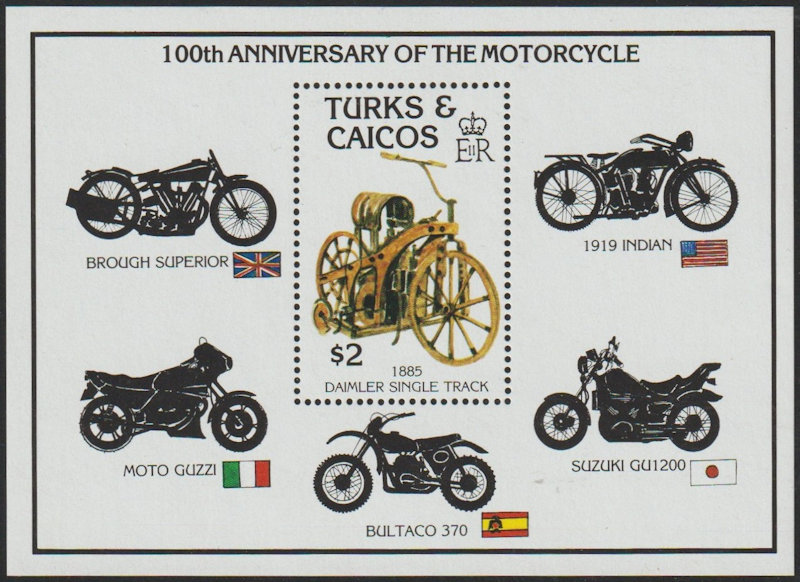
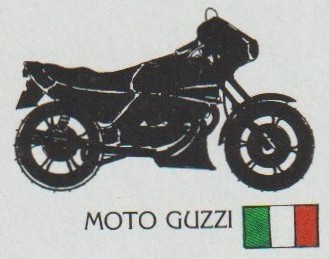
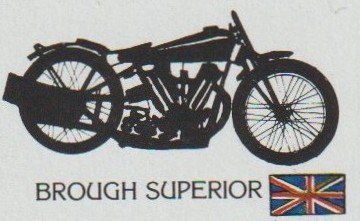
In the border of the block we see five iconic models from different motorcycle brands. Clockwise, an Indian from 1919, a Suzuki GU1200, a Bultaco 370, as well as a Moto Guzzi and the Rolls-Royce of motorcycles: a Brough Superior.
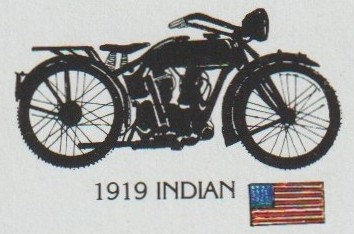
The silhouette images show very few details, so we only have general information at our disposal. Based on the Indian picture alone, I would not be able to identify a specific model, nor with the knowledge that it dates from 1919. It appears to be a single-cylinder with a springer front fork. The Indian motorcycles were built by the Hendee Manufacturing Company. After director Oscar Hedstrom left the company, his assistant Charles Gustafson took over the leadership.
He had gained experience with so-called Flathead engines at Reading Standard and began applying them at Indian as well. The engine was fed by side valves. Unlike most motorcycles, the throttle was on the left, and the ignition could be adjusted with the right lever. Was that the case with this model as well? No idea.
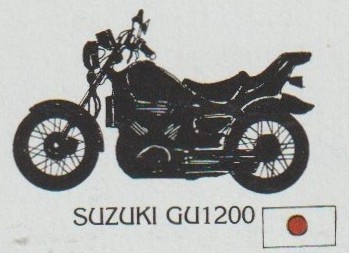
Suzuki does not have a 1200 GU model, but it does have a 1200 GV. So it must be a typographical error because the image is clearly the GV model. In the 1980s the models were not only given a name by number but also a model name. For the Suzi GV 1200 this became Madura.
To counteract the other Japanese brands in the USA, Suzuki developed its first V4 engine block. The GV was the first motorcycle in the world to have a hydraulic clutch and hydraulic valve adjusters, and, like the Honda Magna, it had 16 valves and a shaft drive. You can find more information on the Dutch Suzuki Madura Riders site.
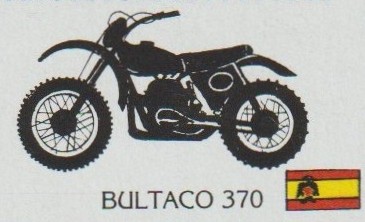
The image of the Bultaco is also unclear. The text states that it is a 370, and three models qualify for this: the Frontera, the Pursang, and the Metisse. It is strange that the front looks like an enduro version with a headlight, while no taillight is mounted, which is mandatory for an enduro.
The name is a contraction of the founder, Don Paco Bultó (the grandfather of Sete Gibernau), and Cemoto (Compania Espanola de Motores, S.A.), and is based in Sant Adrià de Besòs, Catalonia, Spain.
Number four looks like a Moto Guzzi Le Mans 1000 to me. The Guzzi factory was founded in 1921 by Carlo Guzzi, Giorgio Parodi, son of a wealthy shipowner, and Giovanni Ravelli, who died in 1919. The motif of the Moto Guzzi badge, the eagle with outstretched wings, was chosen in memory of this friend. The factory is located in Mandello del Lario in the Italian province of Lecco. The factory has been building motorcycles since 1921.
The first Le Mans series measured just 850cc and were given the designations I, II, and III. In 1984, the Guzzi Le Mans IV with 948cc was presented at the IFMA. The Le Mans 1000 is a sports motorcycle that was produced between 1984 and 1993. After the death of Carlo Guzzi in 1964, the brand passed into various hands, including De Tomaso, Aprilia, SEIMM, and Benelli. Since 2004, it has been under the wing of Piaggio.
The last one is the Brough Superior. George Brough was the son of a bicycle manufacturer, William Brough, who at a later period also started manufacturing motorcycles. George worked in his fathers company, but thought the bikes made there were not of sufficient quality. He started his own motorcycle factory in a garage in 1919, saying his motorcycles would become superior to those of his father. And so the name was born.
George used a J.A.P. (J.A. Prestwick) V-twin engine block of 998cc as power source in the SS100. SS stands for Super Sport. The SS100 is considered the world's first superbike. Elite people wanted to be seen on these motorcycles or in the few automobiles that George made. The famous army officer T.E. Lawrence (better known as Lawrence of Arabia) also bought one, with which he had a fatal accident in 1935.
This picture cannot be considered entirely correct either. The artist probably drew the suitcases on this racing model, which are also always included on the 100SS, in such a way that they would almost be part of the exhaust system.
Since 2013 Brough Superior is brought back to life, and also now Brough is "top of the bill" in motorcycles.
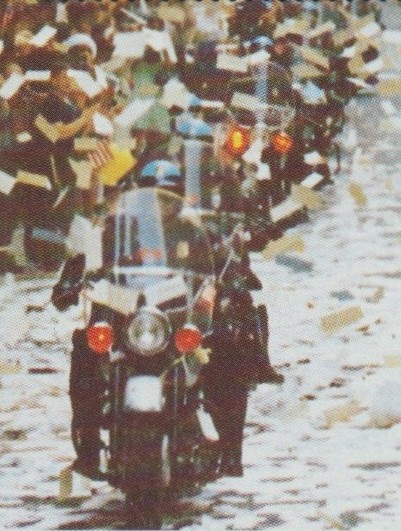
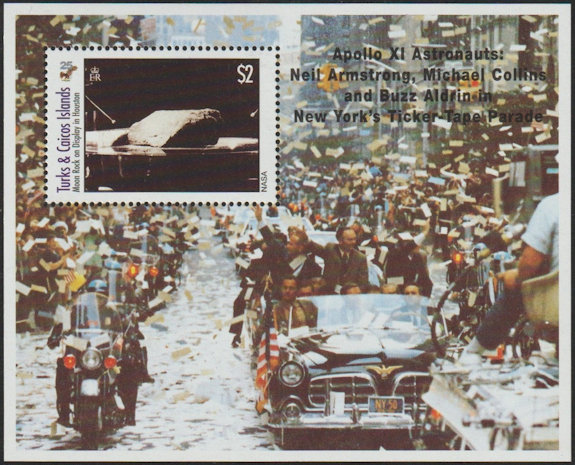
In 1995, the Island Post issued a commemorative series for the first moon landing by the Apollo 11, manned by Armstrong, Collins, and Aldrin. On the last block of the issue (in total eight stamps and two-blocks) a piece of moon rock is shown. However, on the margin of the block, we discover a large line of motorcycle police on both the left and right. The photo was taken during the ticker-tape parade in New York City, which was held on August 13, 1969, in honor of the astronauts.
|
|
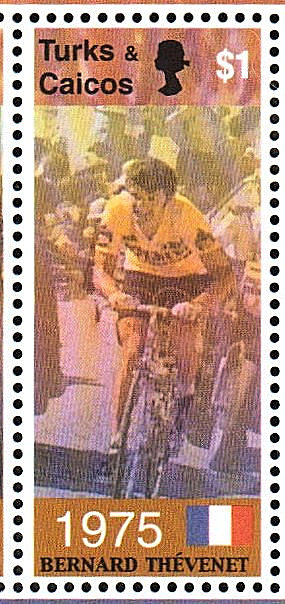
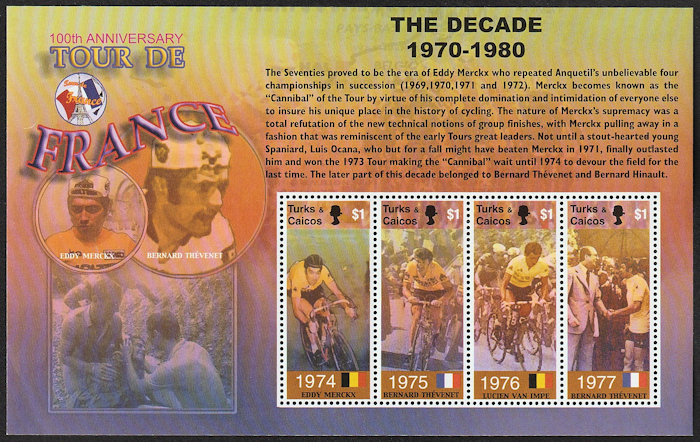
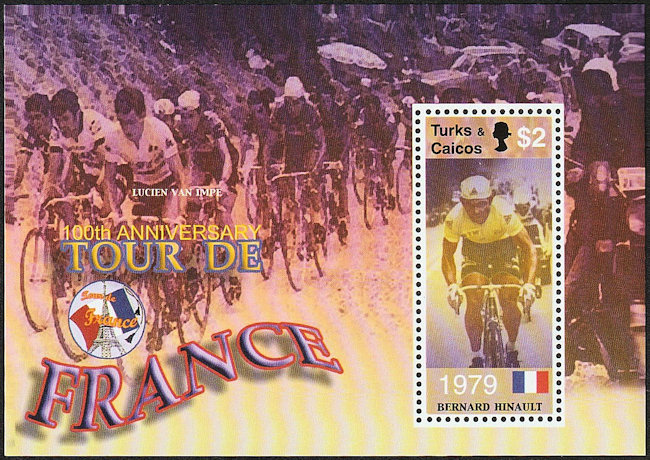
The latest TCI issue up to now that is interesting for us, is part of the omnibus series about the Tour de France issued August 25, 2003. Under the umbrella of I.G.P.C., more than 60 countries issued stamps and blocks with this same theme. Naturally, accompanying motorcyclists can be found in many of the photos used for the series. This is also the case on the two blocks issued for TCI.
The block of four stamps shows the cyclist Bernard Thevenet on the second stamp in the row, with journalists on motorcycles on the left and right.
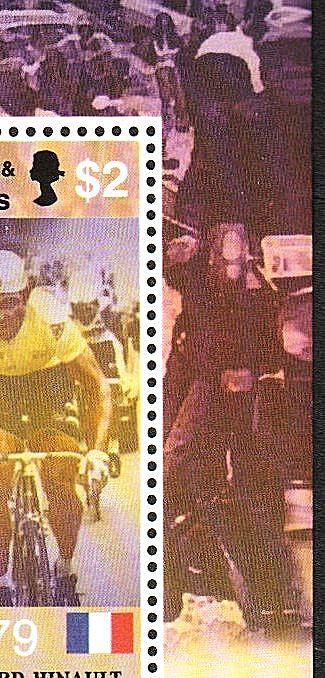
On the second and last block of this issue the motorcycle is printed next to the stamp. The cyclist is also called Bernard, but now Hinault.
It is difficult to determine during which year or stage the photos were taken, because there are much more than 10 photos of the Tour on the internet.
Well, it has become quite a long story, but I hope you found it interesting. Next time we’ll travel on to Bermuda and skip a few BOT countries (they were not smart enough to issue a motor stamp too) to sail to Montserrat.
Hans de Kloet
Top - Back to former page - Home |