"Modern" Chinese Postal Stationery
|
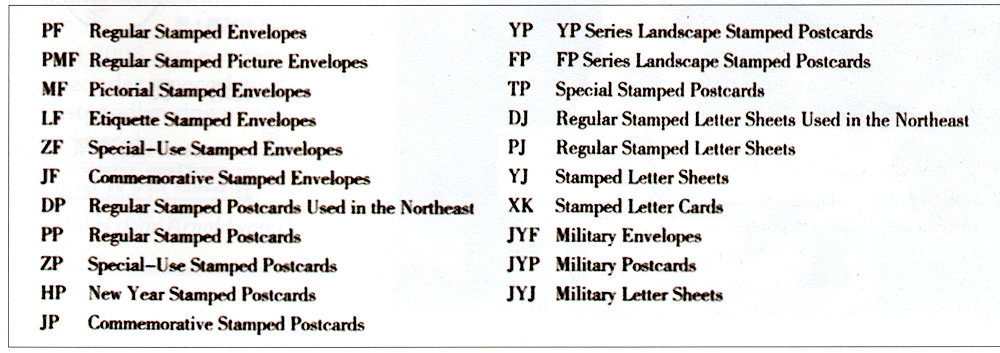
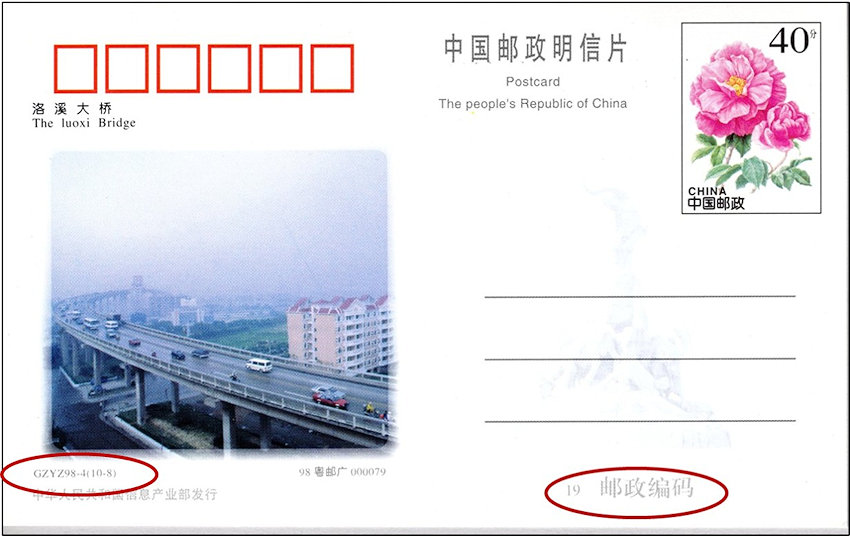

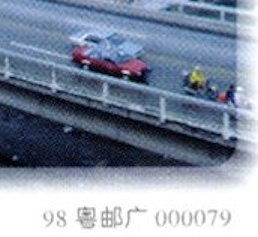
Below is another postal item that, despite looking very official, still fails to meet the criteria.
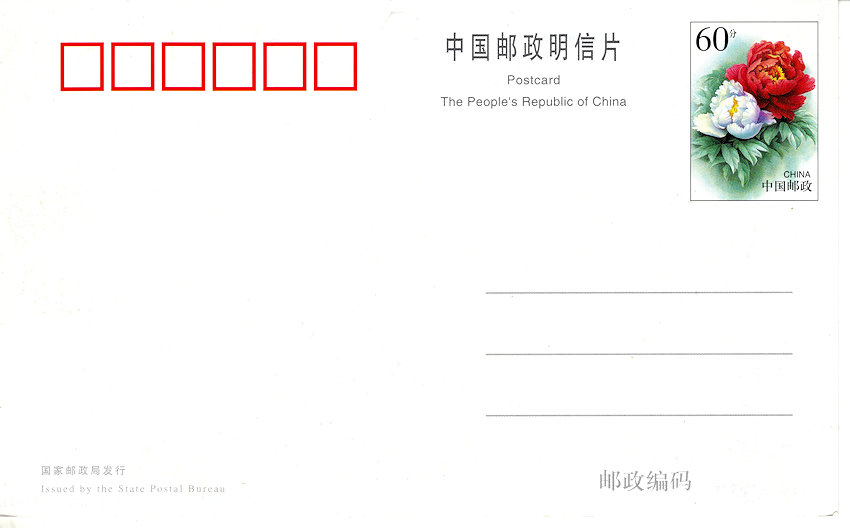
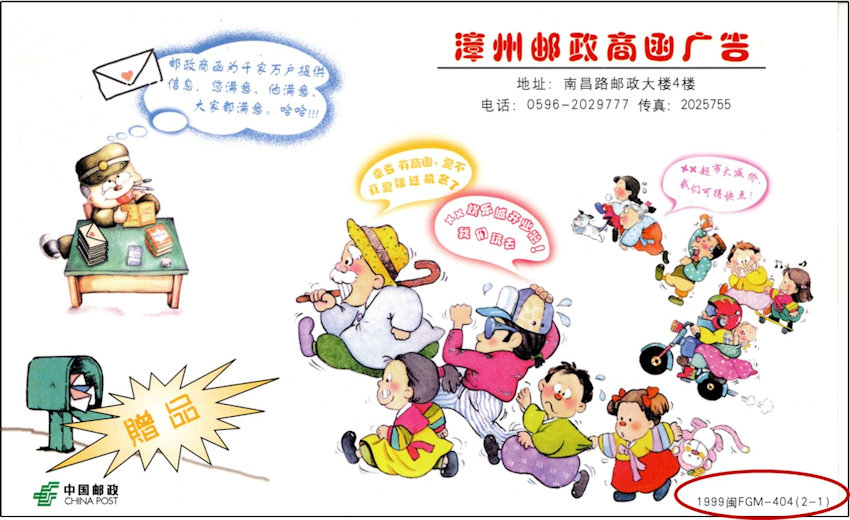

In addition to the unidentified type designation, it is preceded by the year of issue. Year of issue 1999, agency (in Chinese characters), type FGM, serial number 404, card sequence number 1 in a series of 2. The type FGM also does not appear in the table.
So are there no postal items at all that meet the correct criteria? Actually, there are - plenty of them.
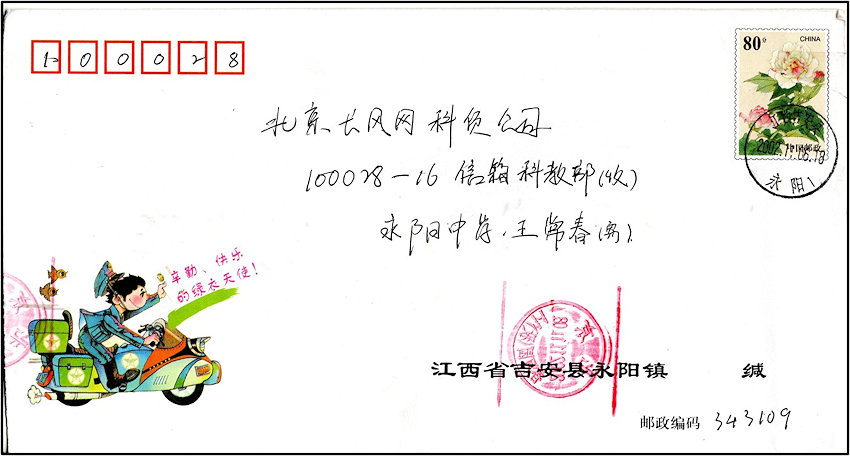
Here a Regular Stamped Envelope (a normally franked envelop). The envelope is franked with an imprinted "Hibiscus Flower 80f" stamp.
The fact that this is an "official" issue is indicated by the type designation "PF." The coding scheme for this type of envelope is: <year>, <series number>, <type>, <sequence number within the series>.
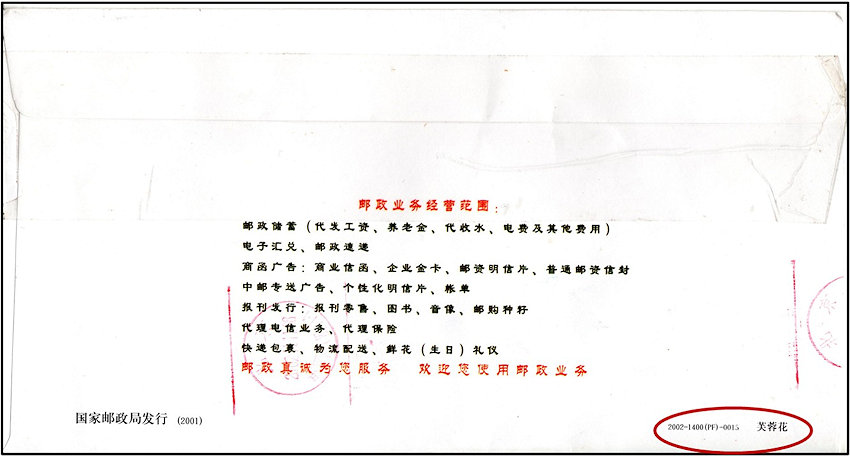

As for envelopes, we also have the types PMF, MF, LF, ZF, and JF.
Here is a fine example of the latter.
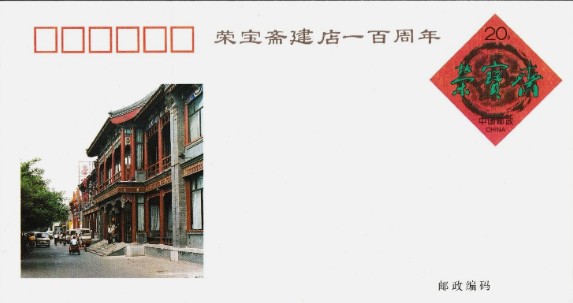
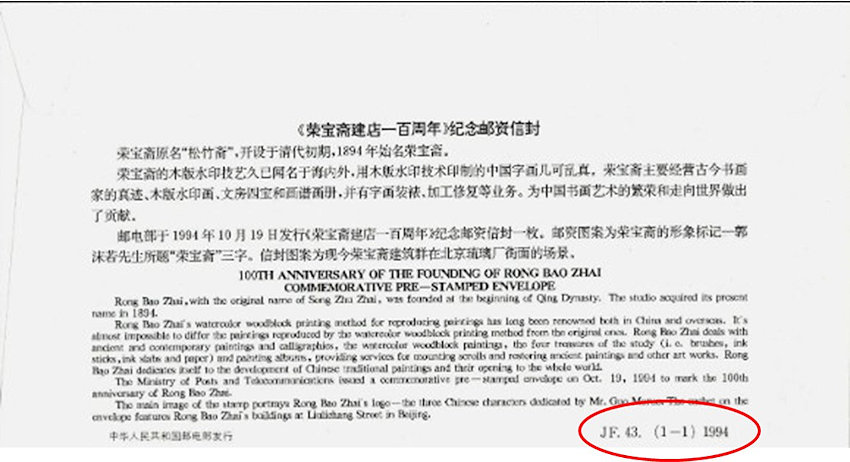

The type designation JF stands for envelope with stamp. Further explanation of the registration number: type (JF), serial number (43), sequence number within the series (envelope 1 in series of 1) and year (1994).
In addition to envelopes, various types of postcards have also been issued, both nationwide and regional.
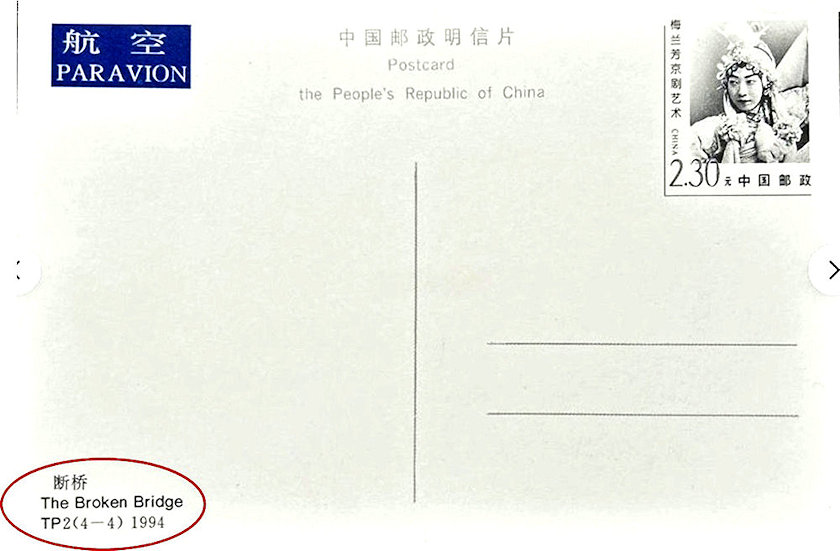
Special stamped postcards can, apart from the code "TP", be identified by the special stamp designs printed directly onto them. The registration number may appear on either the front or the back of the postal stationery item.
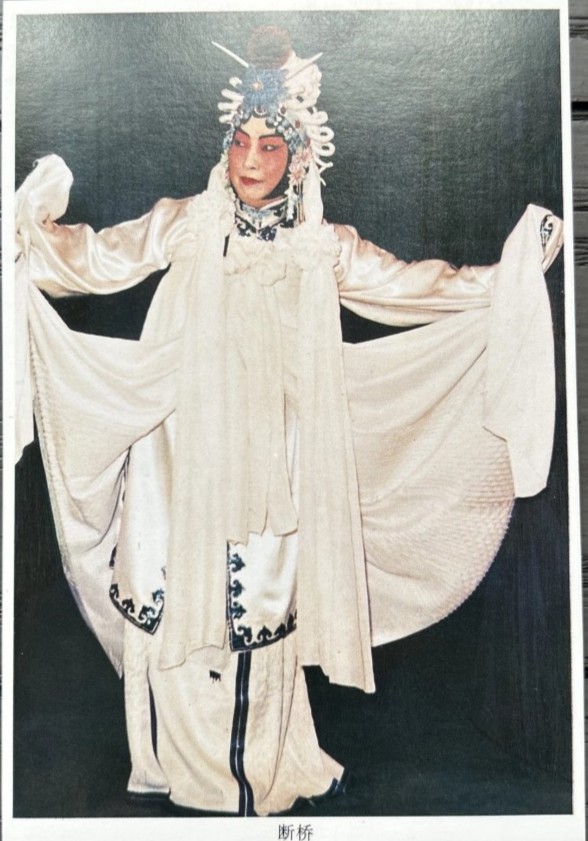
The item shown here is one from a series of 4, titled "Mei Lanfang in the Opera".
The registration number is as follows: type (TP), series (2), sequence number (4 of 4), 1994 edition.
The name of the opera is "The Broken Bridge."

Lottery cards play a very distinct role.
The lottery is managed by the "China Welfare Lottery", under the auspices of the Ministry of Finance. Each card features a lottery number and bears an embossed stamp on the address side. These embossed stamps depict the animal sign of the Chinese zodiac for that particular year. When the first lottery card was issued on December 1, 1991, it featured an embossed stamp of a monkey - 1992 being the Year of the monkey. In 1993, a lottery card with a rooster stamp was released, followed by one with a dog in 1994, a pig in 1995, and so on. The draw takes place on the final day of the Chinese New Year; after that the lucky winner can use the detachable tab containing the lottery number to claim a prize of 5,000 yuan.
In the same way as letters and postcards, lottery cards can be categorized into national (type HP) and regional (types BK and PG) issues. A national version is shown on the following page.
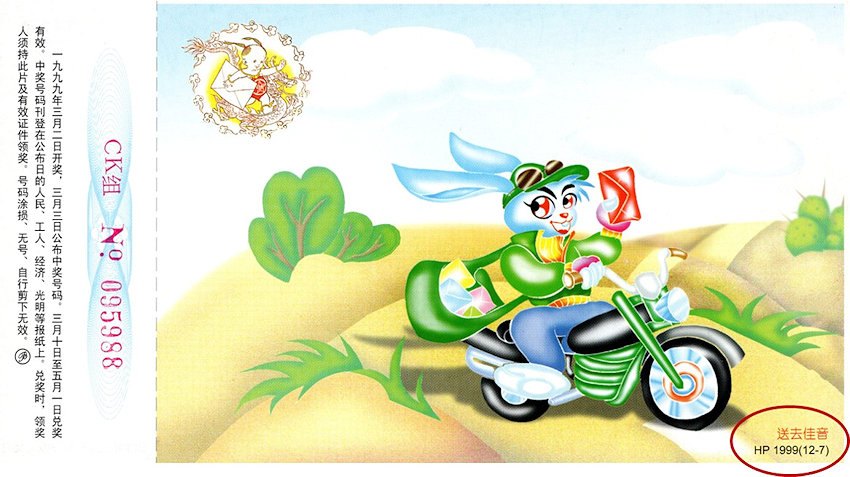
The following card features a type designation (HP), year (1999), and sequence number (card 7 of 12).
The regional lottery cards were primarily ordered at regional advertising agencies by companies. They were sent to the company's employees and clients as New Year's greetings. All additional printing on the regional cards was approved by the postal authorities, and they feature a registration number on the pictorial side of the card, following these schemes:
New Year's cards: <year>, <agency>, BK, <image>, <optional sequence number>
Example of a New Year's card:
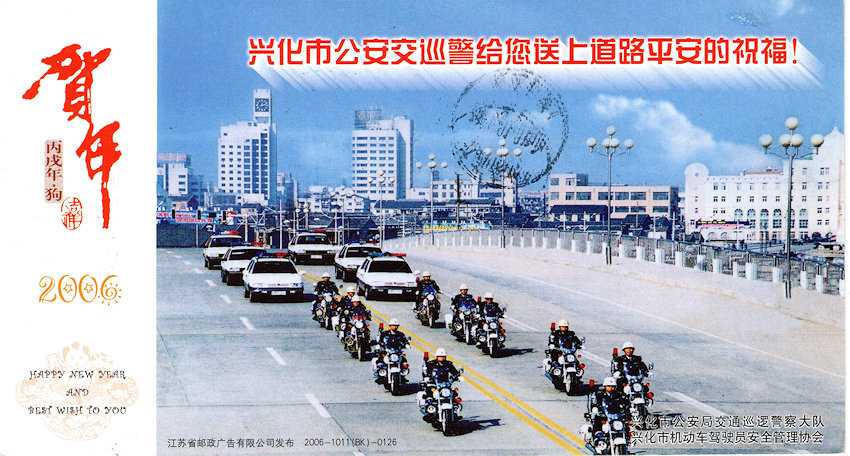
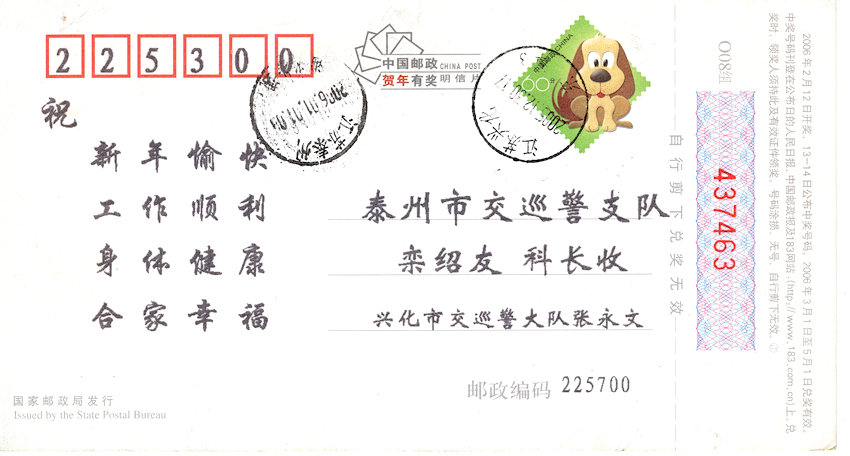

Year (2006), agency (1011), BK, image (0126).
This card was sold in 2006 in the Jiangsu region, presumably as part of a set of four, for ¥ 4.80 (4 yuan and 80 fen). This makes a price of ¥ 1.20 per card, which is significantly higher than the 50-fen postage value. The difference represented a contribution toward a lottery.
Regionally added overprint on cards: <year>, <agency>, BK, <image>, <optional sequence number>
Example of a regionally added overprint on a card:
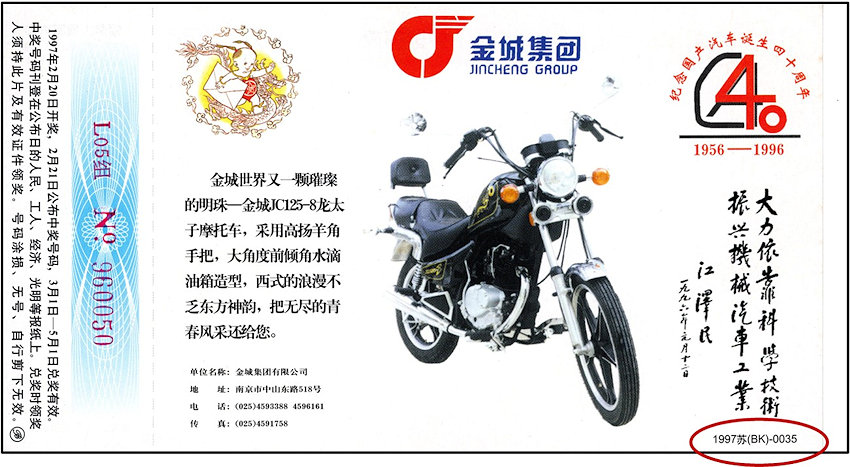
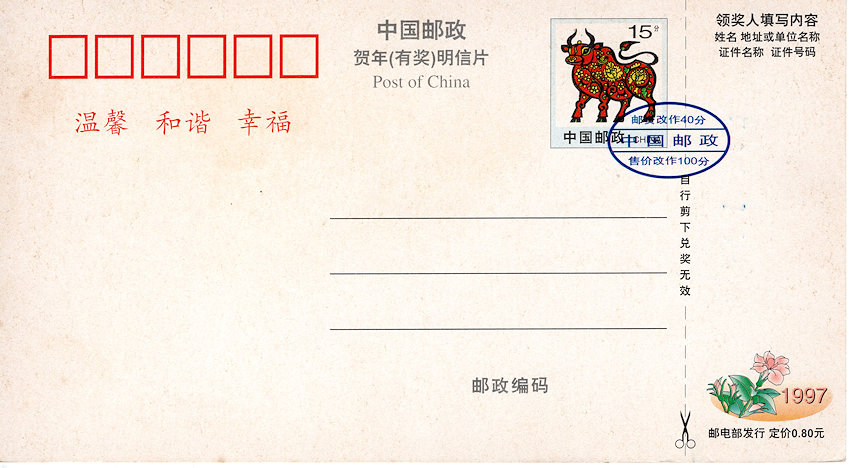
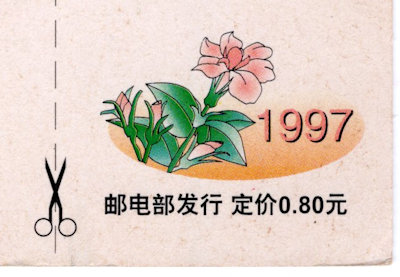

Year (1997), agency (Su in chinese characters), BK, image (0035).
The standard postage value of the card was 15 fen, but due to the lottery contribution, the selling price was 0.80 yuan.
Other lottery cards: <year>, <agency>, PG, <image>, <optional sequence number>
Example other lottery card:
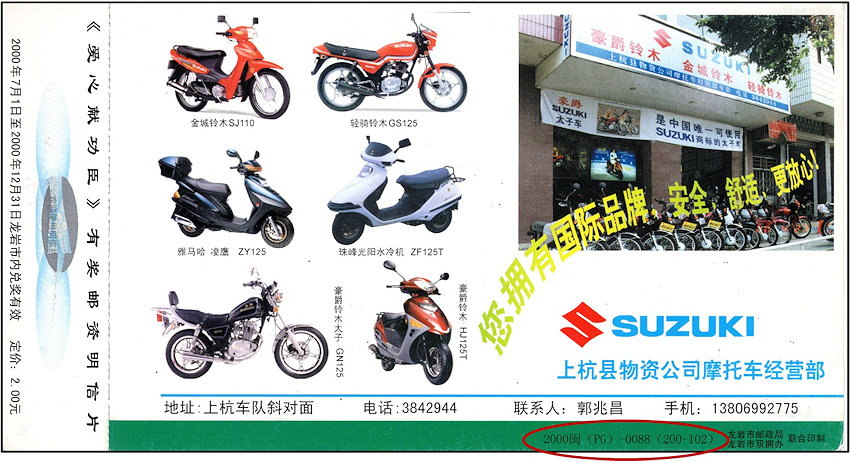

Year (2000), agency (Chinese characters), PG, series (0088), image (102 of 200).
Have we now covered all Chinese postal stationery? The answer is no.
A great many cards have been issued, often official postal stationery items, that feature private overprints applied without the approval of the Chinese postal authorities. Frequently, these cards also lack registration numbers. Such items should better not be included in an exhibition collection, unless the card represents an essential element of the thematic narrative. In that case, it may be displayed, provided it is accompanied by an appropriate description; however, it will not earn any additional points.
However, some lottery tickets have been issued that do display a registration number, but lack a type designation. The following ticket is an example of this.
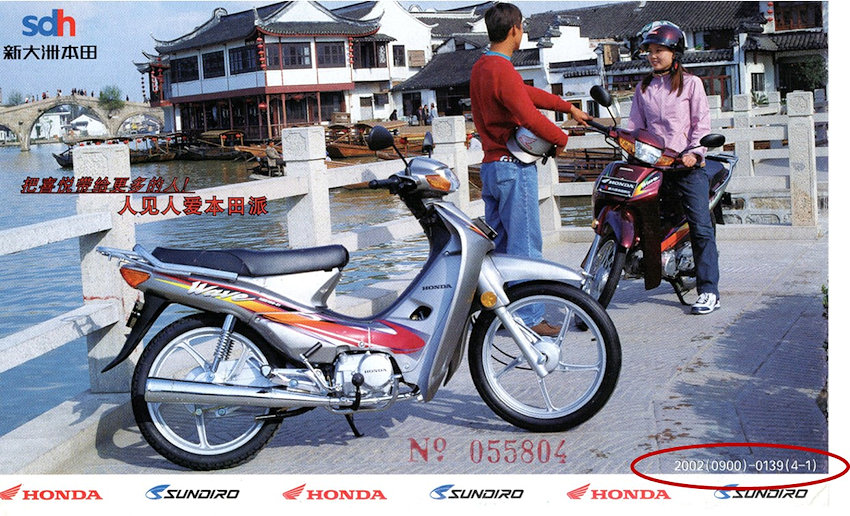
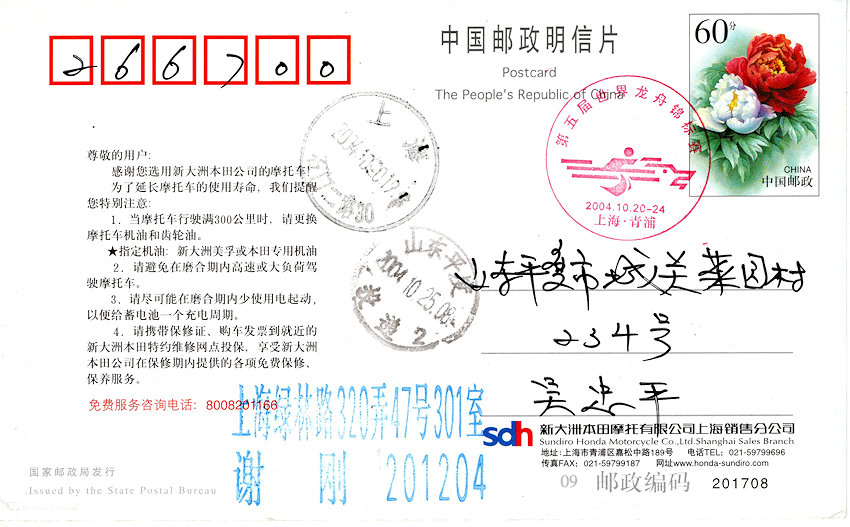

The card bears the following registration number: year (2002), agency (0900), series (0139), and sequence number (card 1 of 4). The lottery number on the front is 055804.
This is said to be a private issue. But could there be individuals or companies that organize a lottery, using such pre-stamped postal items, with the knowledge of the authorities?
For cards issued after 2008 that have a registration number without a type designation, the procedure regarding postal approval is not yet clear. This requires further investigation. Does the card mentioned above, from 2002, also fall into this category?
Other examples that still raise questions for me:
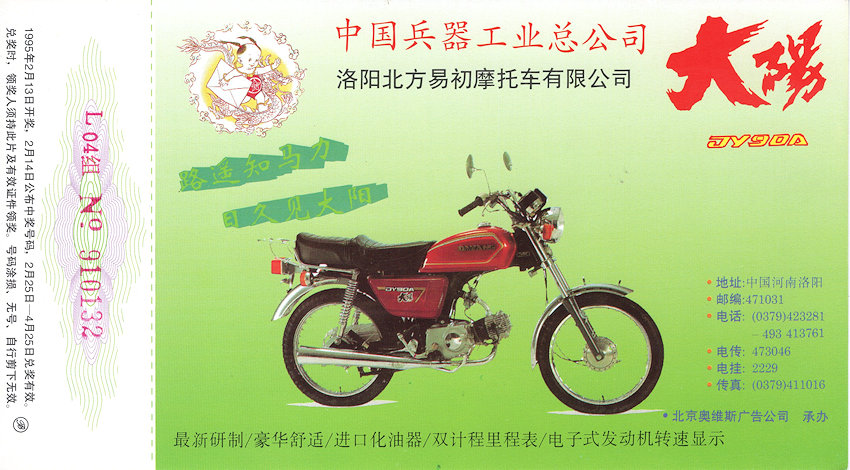
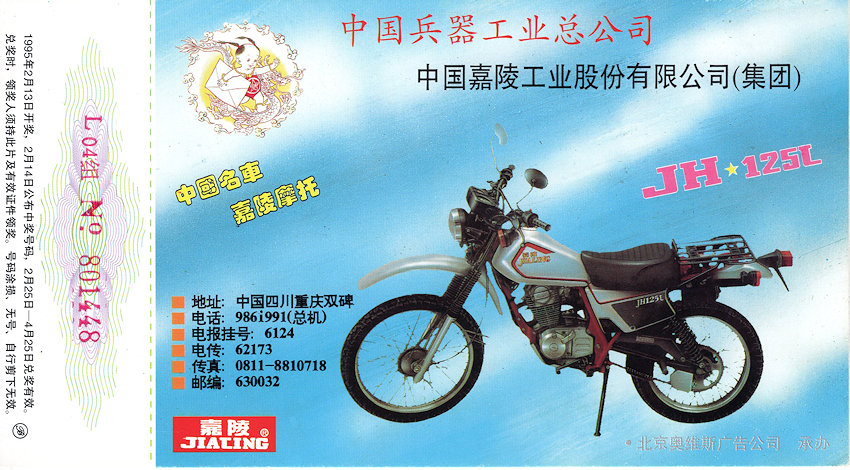
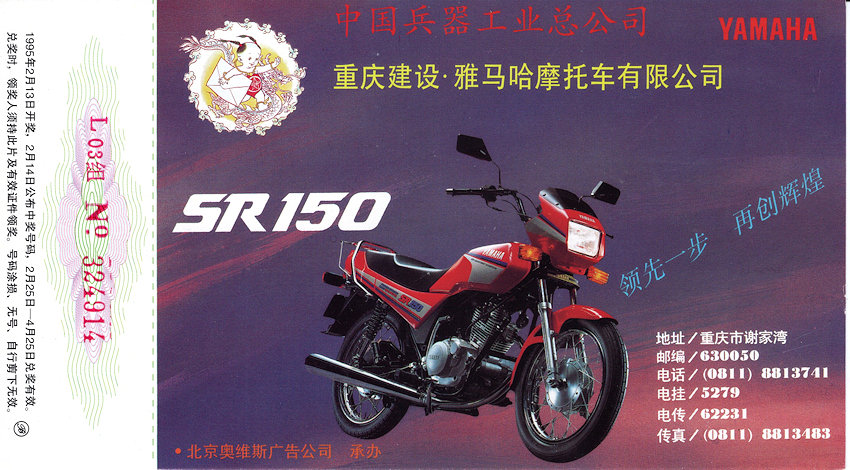
All three items feature a small box on the card containing address details, postal code, telephone number, telex, etc. There is no registration number on the front or back of the cards, and according to this article these are private issues. But they do include a lottery slip.
I hope you will now look at Chinese postal stationery with different eyes. If more becomes known in the future, I will report it.
Nico Helling
Original article: Peter Lang, Motivgruppe Musik e.V.
Translation: Arnold van Berkel
Images: Nico Helling en Delcampe (card 5)