The International Motorcycle marathon of 1948:
a race through a divided Europe
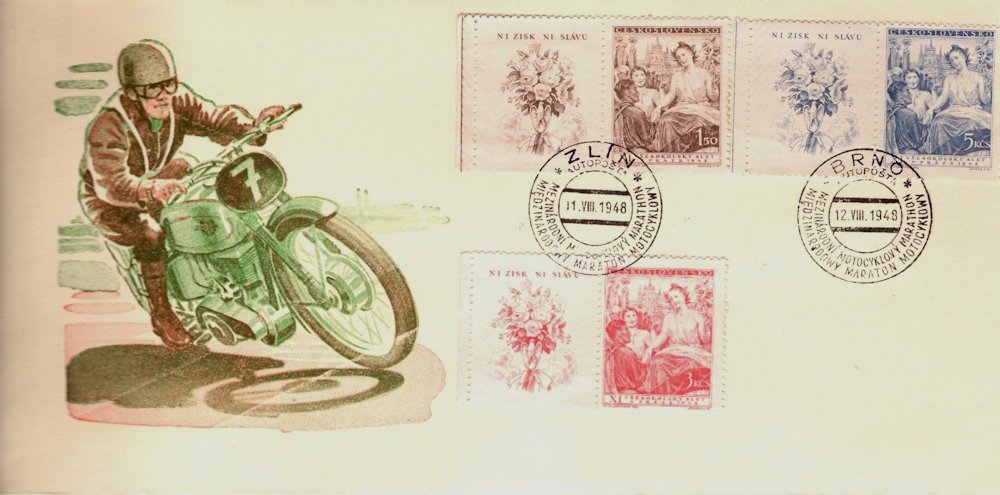
While gathering material for the upcoming auction, I came across this Czech envelope with cancellation:
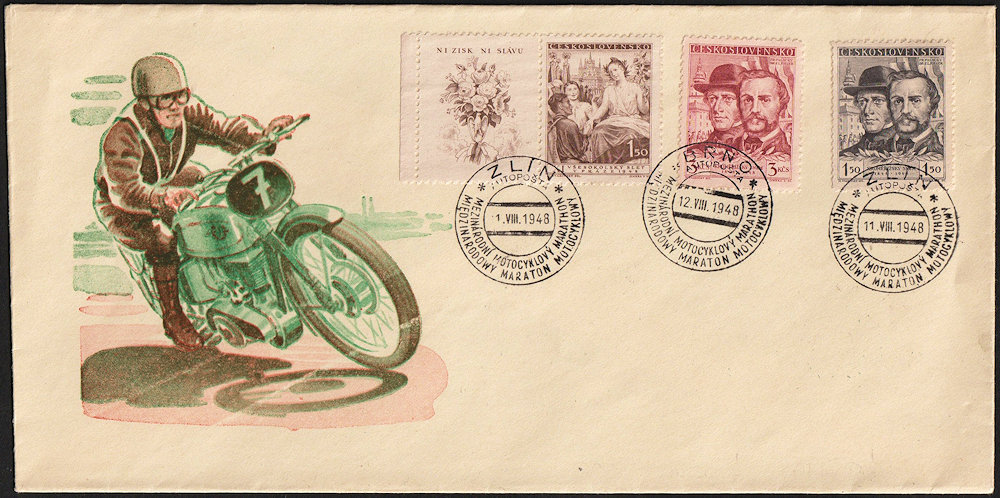
The envelope we know from various event-related postmarks (including those from the Golden Helmet races), but what is unusual here is the odd placement of the dates. The first in the sequence is a postmark from Zlín (1 VIII 1948), the second is dated 12 VIII 1948 and was applied in Brno, while the third—dated the 11th—was applied in Zlín.
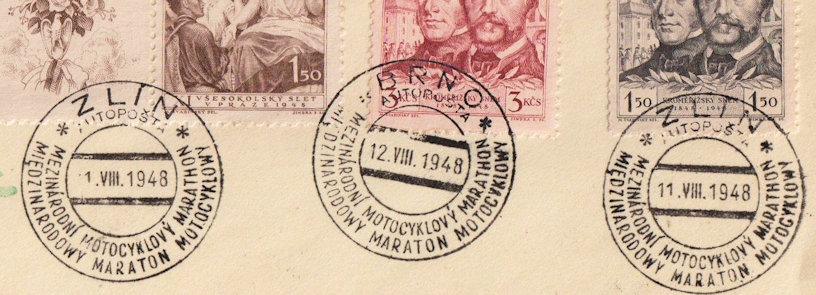
So, I took a look for it on Google. Stamps 2 and 3 are the ones issued on June 20th to mark the 100th anniversary of the Krems Constitutional Assembly, while the first one is the stamp for the 11th Sokol Congress, which was already available as of March 7th.
From August 9 to 15, 1948, the first International Motorcycle Marathon took place, a gruelling reliability ride covering approximately 2,700 kilometers through Poland and Czechoslovakia. The event was not only a sporting challenge, but also a symbol of the reconstruction of Central Europe following the Second World War. Ultimately, the Polish national team managed to win the Grand Prix.
The marathon consisted of seven stages and took participants over damaged asphalt roads, cobblestone sections, unpaved mountain passes, and muddy country lanes. The route was deliberately designed to put both the riders' skills and the reliability of their motorcycles to the ultimate test. At a time when much of the infrastructure remained severely damaged, every single kilometer posed a challenge.
Beyond its sporting nature, the marathon also held political significance. The collaboration between Poland and Czechoslovakia was part of the post-war rapprochement between the two countries. The cross-border route was intended to demonstrate that cooperation, industry, and technology played a key role in the reconstruction of the region.
Important stages
Although the full route is no longer completely documented, certain cities played a central role. Wrocław served as the spectacular finish point of the competition. The final stage concluded there at the Olympic Stadium, where the remaining participants had to complete one last speed test on the cinder track.
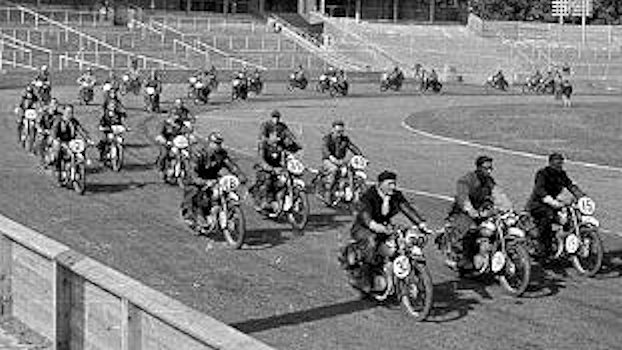
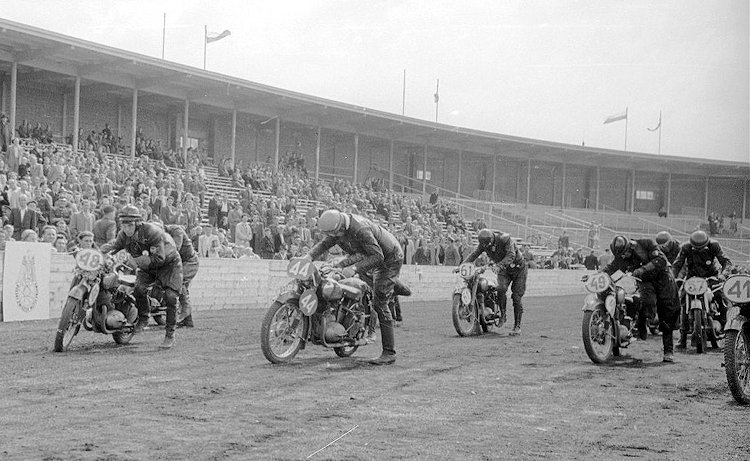
Around seventy riders reached the finish line, cheered on by thousands of spectators.
The Gazeta Wroclawska provided an extensive photo report of the final day.
On Czechoslovak territory, the section between Zlín and Brno was considered one of the most demanding parts of the marathon. The route wound through hilly Moravia, following narrow roads with steep inclines, sharp bends, and poorly maintained cobblestones. For the motorcycles in particular, this was a severe test.
Strict checkpoints
There were numerous checkpoints along the route. At official time-control points, participants were required to check in at the exact designated time; arriving either too early or too late resulted in penalty points. In addition, there were secret checkpoints in mountainous areas and forested sections to prevent drivers from taking shortcuts and deviating from the prescribed route.
At the end of each stage, the motorcycles were placed in a secured parc fermé, where no maintenance by mechanics was permitted. Riders were required to carry out any necessary repairs themselves while on the route, using only the tools they had with them.
Jawa proves its quality
During the marathon, it were the Czechoslovakian Jawa motorcycles that particularly drew attention. The Jawa 250 Pérák was known as one of the most modern motorcycles of its time. Thanks to its advanced suspension, compact engine-gearbox unit, and reliable two-stroke engine, the machine proved exceptionally well-suited for the demanding conditions of the marathon.
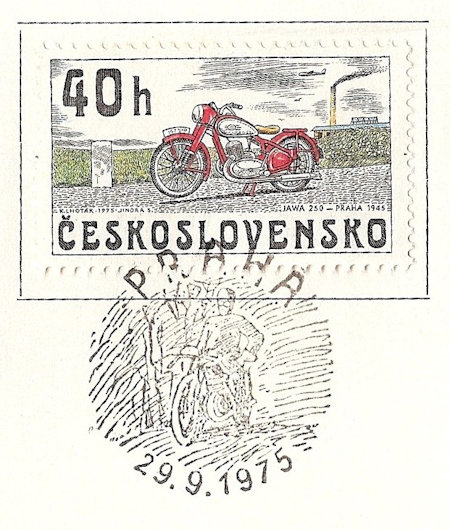
The gear-shifting mechanism and the protection of vital components against dust and mud also gave the Jawa a technical advantage. While many competitors encountered mechanical problems, the Jawa engines remained remarkably reliable throughout the long stages.
The Riders
The Czechoslovak factory teams were represented by experienced racers and test riders who needed to be not only fast, but also technically skilled. Names such as František Juhan and Václav Stanislav rank among the pioneers of post-war Czechoslovak motorsport. While on the road, they were entirely responsible for the maintenance of their motorcycles. In the event of a breakdown, they had to carry out repairs themselves by the roadside - all while the clock kept ticking toward the next checkpoint.
Historical significance
The 1948 International Motorcycle Marathon was much more than a motorsport event. The competition demonstrated the technical progress of the post-war motorcycle industry and underlined the cooperation between two countries in the process of rebuilding themselves after the war. At the same time, the marathon laid the foundation for later international reliability runs and contributed to the reputation of brands such as Jawa.
Although many details of the original route have been lost in due time, the 1948 marathon remains a remarkable chapter in the history of European motorsport: a competition in which endurance, technical skill, and perseverance took center stage.
Postmark issues
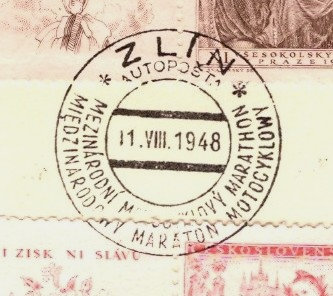
The postmark used at the mobile post office in Zlín likely became defective during use, causing the first '1' in '11' to no longer make proper contact with the paper. I have several postal items from this event featuring this postmark, and on most of them, that '1' is either partially or completely missing.
Hans de Kloet
Top - Back to former page - Home |