Silver stamps PostNL
Dutch PostNL regularly issues "silver stamps". These aren't regular stamps (partially) printed with silver ink, but thin silver plates that resemble a stamp. The silver used is 925 silver, also known as sterling silver. This means it's 92.5% real silver, with 7.5% other metal, usually copper.
Although they may be used to send mail, they are, of course, purely intended as collector's items for enthusiasts. Therefore they always feature an image of something of interest to a specific group of collectors, and are delivered in a nicely designed cardboard cover (PostNL calls it a "passe-partout cover") with photos of the depicted subject and some information about it. The edition of each stamp is limited to 2,500.
In newsletter 152 it was already announced that a series of four of these silver stamps would be issued this year, featuring images of what PostNL calls "legendary motorcycles from our own country". At that time only the first two stamps were known and available, but now all are.
Because the images on both the stamps and the cover come from Yesterdays (Dutch company that sells classic motorcycles), it's easy to find them and other information about the motorcycles in Yesterdays' online archive. So let's take a look at which icons of the Dutch motorcycle industry PostNL has selected.
The first stamp depicts the 1919 Simplex model PM, with a 300cc "Inlet over Exhaust" engine from the Swiss company MAG. The same frame was also available as a model PV with a MAG V-twin engine.
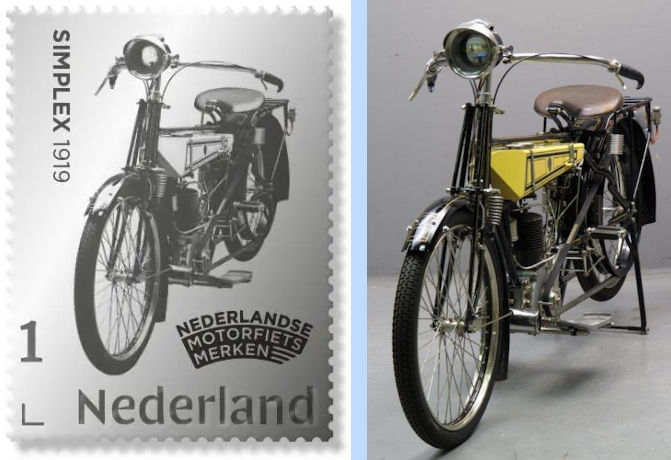
The motorcycle has a direct belt drive from the crankshaft to the rear wheel, so no gearbox or clutch. Not unusual at that time, but practically impossible to use in modern traffic. Especially when combined with the substandard brakes: a rim brake on the front wheel and a brake pad in the belt pulley on the rear wheel. To stop, you have to turn off the engine, using the valve lifter that lifts the exhaust valve, apply both brakes as firmly as possible, and hope for the best. And then, once you're ready to go again, you have to start the bike again by pedalling.
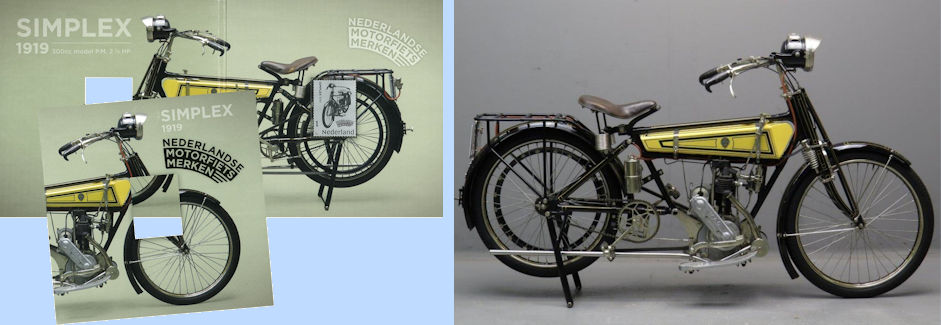
Simplex began manufacturing bicycles in 1889. It built its first car in 1898, and the first motorcycle followed in 1902. Motorcycle production continued until the late 1930s.
The total number of motorcycles built by Simplex is unknown, but Simplex is certainly not the largest Dutch motorcycle brand. However, it is the manufacturer of the most powerful Dutch motorcycles, using MAG V-twin engines up to 1100cc!
A very comprehensive overview of Simplex's entire history, with many photographs of vehicles still in existence, is described in the book "Simplex, Nederlandse fabriek voor rijwielen, motorfietsen, bromfietsen, automobielen en railvoertuigen" by Pieter van der Ham (ISBN 9789070674410).
A nice detail for motorcycle philatelists: Simplex also had beautiful closing seals made, featuring, among other things, images of a motorcycle.
The second stamp depicts a Burgers motorized bicycle, equipped with a 100cc JLO clip-on engine with two gears, from 1934. In this case, a low frame, intended for ladies and clergymen, who at that time still wore long robes.
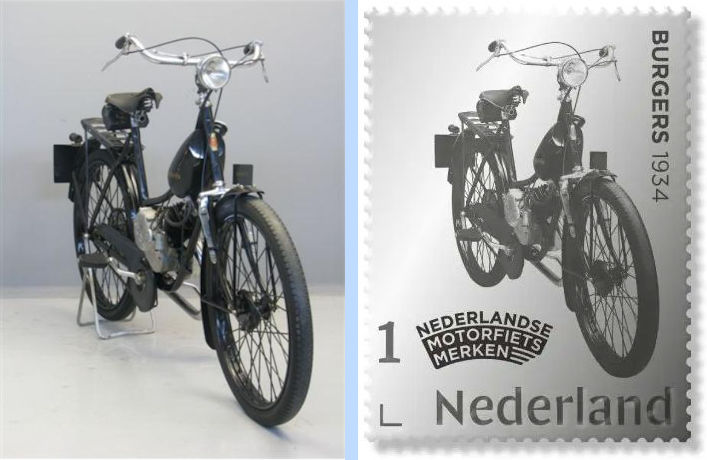
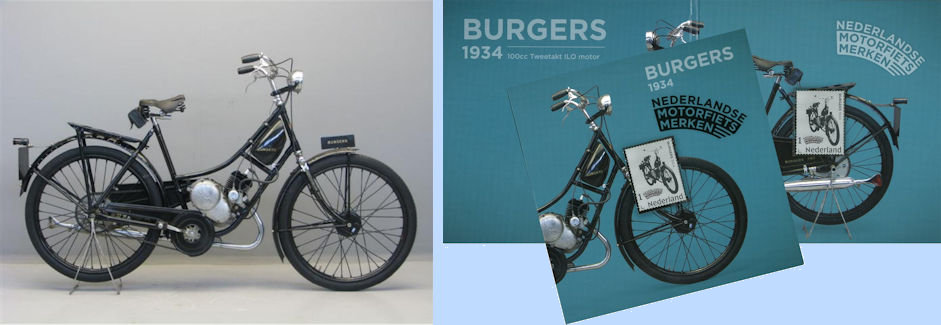
Burgers is also known as Burgers E.N.R., with the added abbreviation standing for "First Dutch Bicycle Factory" (in Dutch language). Burgers began producing bicycles in 1869. Not yet chain-driven bicycles, but "vélocipèdes" with the pedals mounted to the front wheel.
Burgers continued as manufacturer until 1961. After that, Pon, which had become the owner, continued to sell bicycles under the same brand name, but these were produced elsewhere.
Not much is known about Burgers' motorcycle production. It is clear, however, that it was a byproduct of the bicycles. In 1901-1906 lightweight motorcycles were shown in the annual "prijscouranten" (price lists), but I haven't been able to find out how many of them were sold. In the 1920s, motorcycles with larger single-cylinder four-stroke engines were sold, but they strongly resembled English motorcycles of that period. So, it's possible that these weren't Burgers' own products but rather badge engineering.
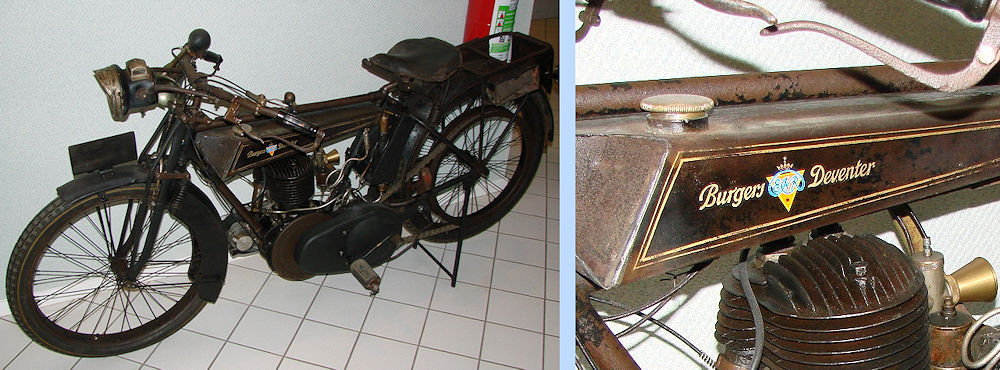
One of few surviving Burgers four-stroke motorcycles.
The tank logo proudly mentions "Burgers E.N.R." as brand name.
In 1932, Burgers introduced motorized bicycles with 74cc Sachs and 100cc JLO clip-on engines. One of these is featured on the silver stamp. However, this production likely didn't last long.
A good overview of Burgers' history, including the motorcycles built, can be found at burgers-enr.net.
The 3rd stamp shows a Sparta with 200cc Villiers engine from 1950.
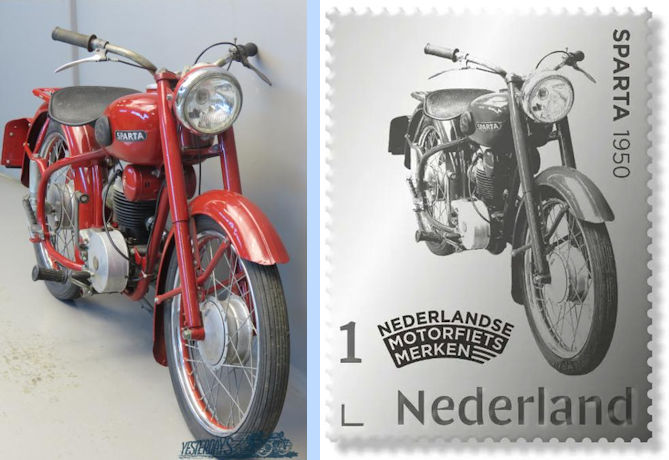
As always a two-stroke engine, in this case, as in most Spartas, a single-cylinder. Later, Sparta produced a single model with a JLO two-cylinder. It's a typical "utility motorcycle": reliable, inexpensive, and easy to use and maintain. Exactly what was needed in the post-war years.
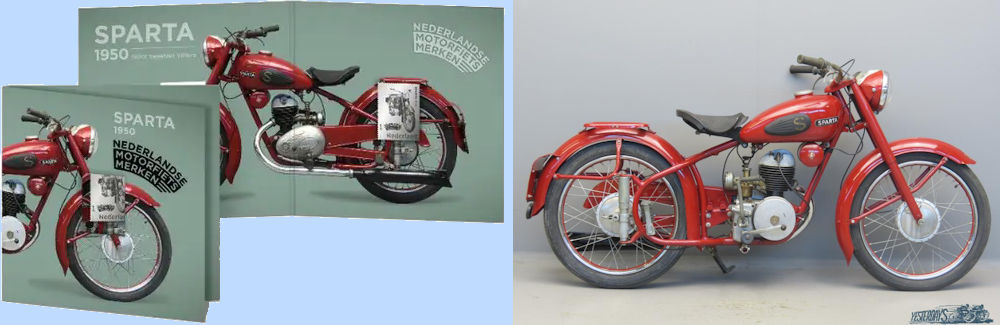
Also Sparta began in 1917 as a manufacturer of bicycle parts, and only later started to produce complete bicycles. It wasn't until 1931 that the first "motorcycle" appeared, clearly a bicycle with the very first 74cc clip-on Sachs engine. In 1934 the first model was introduced that is more like a real motorcycle, equipped with a 100cc Villiers engine. Production was limited for the first few years, at around 300-400 units per year, but with the introduction of the first model with a 120cc JLO engine, sales rapidly increased to around 1,500 units per year.
However, Sparta's heyday came in the early 1950s, when more than 3,000 motorcycles were built annually. In total, Sparta sold over 26,000 motorcycles, making it by far the largest motorcycle manufacturer in the Netherlands. Sparta's history is extensively described in the book "Sparta, vernuft en volharding" (in English: Sparta, Ingenuity and Perseverance). Regarding the motorcycles, their memory is kept alive by the active Sparta Motor Club, with approximately 230 members - see www.spartamotorclub.nl.
The fourth, and last, stamp depicts an Eysink Koerier with 175cc JLO engine.
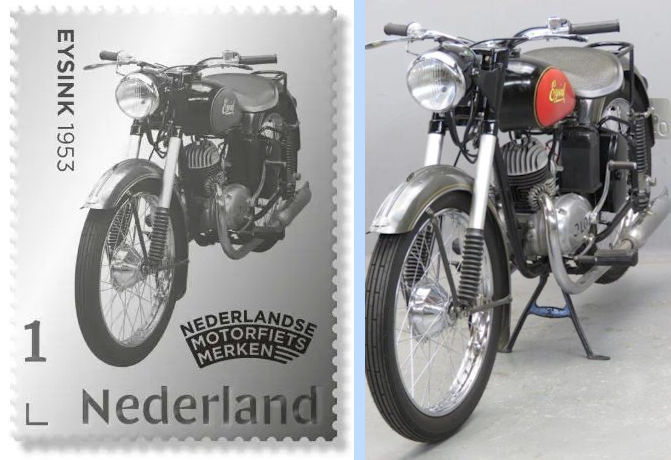
Also a single-cylinder, two-stroke, from 1952. Like the Sparta, a typical utility motorcycle from the early 1950s. Eysink produced three different models during that period, besides the Koerier with the 175cc JLO engine the already somewhat outdated Jubileum, still without rear suspension, with a 125 or 200cc Villiers engine.
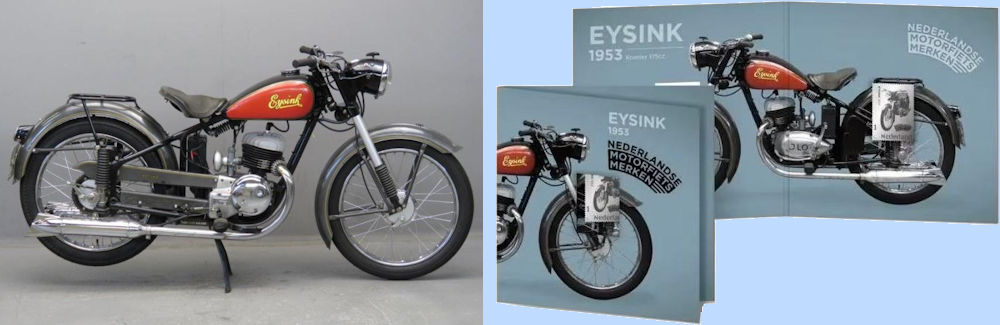
The first means of transportation built by Eysink were also bicycles, starting in 1896. But as early as 1897, it built its first car, and over the next 20 years, it would grow into the largest car manufacturer in the Netherlands. Eysink is estimated to have produced around 330 cars in total, of which, strangely enough, only one remains.
Motorcycle production began at Eysink in 1901 and lasted until 1953. Besides the typical utility motorcycles, Eysink also built fast, heavy models. The best known is undoubtedly the Alpenjager from the 1930s, equipped with 350 and 500cc single-cylinder 4-stroke engines from various brands, including the 500cc Rudge/Python 4-valve engine.
Eysink was also successful in motorsports. Their greatest success was Dick Renooy's 1948 TT victory in the 125cc class.
I haven't been able to find out how many motorcycles Eysink built in total. But it's almost for sure the second-largest Dutch brand, well behind Sparta.
Paul Essens
Top - Back to former page - Home |